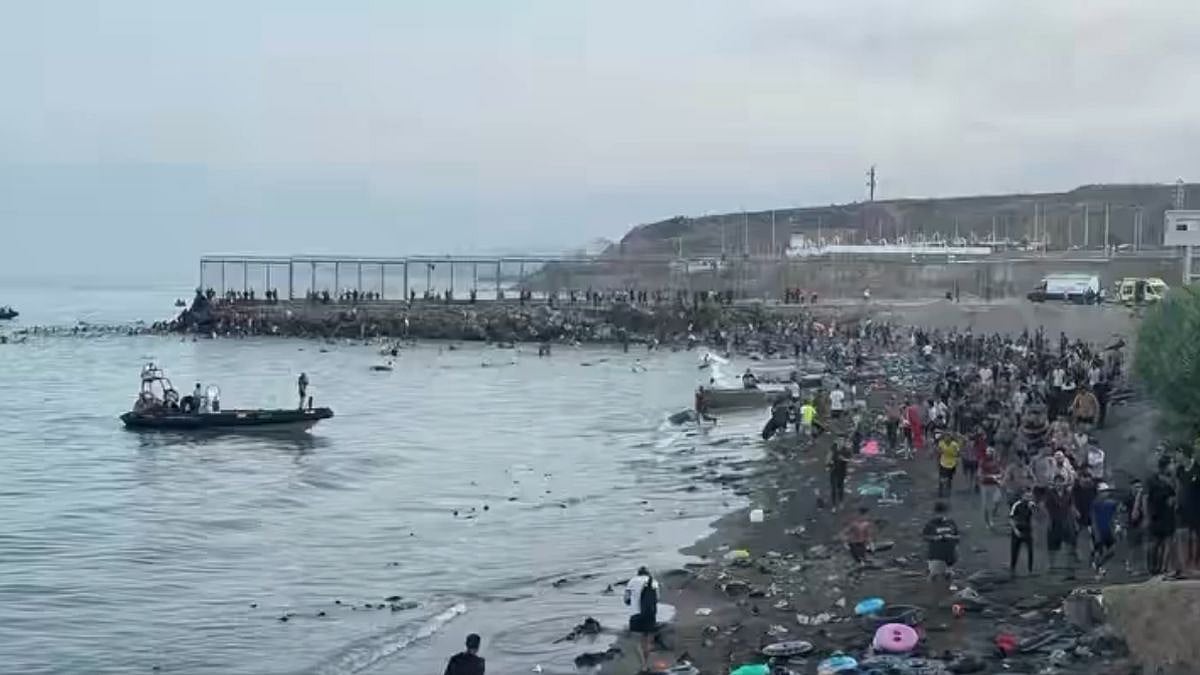
Ceuta, July 31, 2026: Around 60,000 migrants entered Spain's autonomous city of Ceuta from Morocco over the past 24 hours, according to Ceuta President Juan Jesús Vivas. The figure is equivalent to around 70 per cent of the city's regular population.
At least 34 migrants died during the mass crossing.
“The situation that Ceuta is going through is absolutely unsustainable,” Vivas said on Friday.
The crisis escalated on Thursday and continued into Friday, with security forces clashing with migrants on the Moroccan side of the border. Hundreds of migrants gathered on a hill overlooking Ceuta before Moroccan forces dispersed them with tear gas, while others continued swimming into Spanish territory. At the same time, many migrants walked back from Ceuta to Morocco to return home.
Prime Minister Pedro Sánchez, speaking in Ceuta, condemned the border breach, calling it "a violation of Spain's territorial integrity."
The Spanish leader blamed human smugglers, saying they "deceive so many young people, and ultimately lead many of them to their deaths — whether in the ocean or, as in this case, at Spain's border in the autonomous city of Ceuta."
Deaths And Humanitarian Concerns
Rachid Sbihi, who heads a local workers' association representing Civil Guard officers, described the situation as a “serious humanitarian crisis”, saying thousands of migrants, including unaccompanied children, spent the night in parks and on pavements, while others wandered the streets.
“People are still entering. The reinforcements, including Spanish military troops, that have arrived are only helping the injured and other humanitarian efforts,” he said. "It's chaotic."
Sbihi said many of those who died drowned, while others were killed in a stampede at the breakwater fence at Tarajal beach near the Morocco border crossing.
Ahmed Karim, a 33-year-old Moroccan migrant, said he crossed into Ceuta because of a lack of employment opportunities.
“Many people want to go to Europe, America, but they don't have the opportunity,” Karim said.
On Friday morning, the waters near the border fence were strewn with buoys, shoes and other belongings left behind by migrants.
Moroccan authorities deployed additional police personnel, used water cannons and fired warning shots to prevent more crossings, according to rights groups.
“Despite the heavy police presence, people crossed through the waterway, while the land border remained closed,” said Achraf Maimouni, a human rights activist in Fnideq.
Maimouni said migrants detained at the border were taken farther into Morocco, away from Ceuta, but added, “People are still coming.”
Authorities Differ On Cause
Morocco's ambassador to Spain, Karima Benyaich, expressed hope that those who crossed into Ceuta would return and described the situation as difficult.
“We have always prioritised legal, orderly and safe migration for all,” she said.
Authorities in Ceuta and Madrid linked the sudden influx to a recent Spanish Supreme Court ruling that migrants arriving by sea could not be summarily deported, unlike those entering by land or climbing the border fence.
Sánchez said migrant smugglers had misinterpreted the ruling but acknowledged it may have contributed to the situation.
“It appears that this interpretation of the Supreme Court's ruling spread like wildfire over the past few hours through the networks of human trafficking organisations, triggering the kind of mass surge we witnessed yesterday,” Sánchez said.
However, some Moroccan activists questioned whether the ruling was responsible, arguing that most migrants were unlikely to have known about the court's decision.
Spain remains one of Europe's main destinations for migrants seeking better economic opportunities or fleeing violence. Migrants attempting to reach Ceuta often swim from the Moroccan town of Fnideq, while others make the shorter crossing from Belyounech.
Political Fallout Widens
The developments triggered political reactions in Spain and abroad.
Earlier this year, Sánchez's government granted residency and work permits to hundreds of thousands of undocumented migrants already living in Spain, though those who entered irregularly after January 1, 2026, were excluded.
Critics argued the policy encouraged more migrants to attempt the journey.
“Sánchez allows Spain to be invaded through Ceuta,” Spanish conservative politician Isabel Díaz Ayuso wrote on X.
Sánchez rejected suggestions that the legalisation policy was linked to the current crisis.
Italian Premier Giorgia Meloni threatened to suspend Italy's participation in the Schengen open-border agreement with Spain, while French Interior Minister Laurent Nunez announced tighter border checks with Spain.
The Spanish government rejected claims that its migration policy had caused the crisis, saying smugglers had exploited interpretations of the Supreme Court ruling. It also summoned Italy's ambassador in Madrid following Meloni's remarks.
The unrest also spread to Melilla, Spain's other North African territory, where migrants clashed with Moroccan police, throwing stones and setting police vehicles on fire, according to local media and rights groups. Authorities reported injuries among security personnel and dozens of arrests.
Omar Naji of the Moroccan Association of Human Rights said the attempted crossings into Melilla appeared to be linked to events in Ceuta.
Earlier in the week, Vivas had warned that migrant reception centres in Ceuta were already under pressure because of rising sea arrivals.
Spain's Interior Ministry did not confirm the number of migrants who entered Ceuta and said updated migration figures would be released on Monday. Spanish media estimated that between 30,000 and 49,000 migrants crossed in the past 24 hours, while an unnamed Civil Guard member put the figure at around 49,000.
Sbihi said it was difficult to determine an exact number but believed tens of thousands of migrants had reached Ceuta.
Ceuta has been under Spanish control since 1580 and has a mixed population of Christians and Muslims, as well as Spanish and Moroccan residents, who generally live together peacefully.
To get details on exclusive and budget-friendly property deals in Mumbai & surrounding regions, do visit: https://budgetproperties.in/

