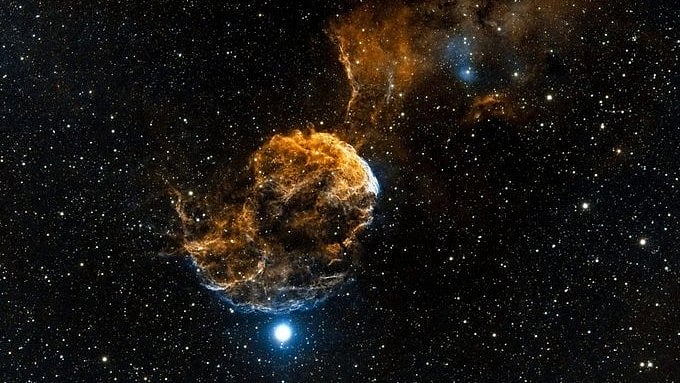
Scientists have, for the first time, found evidence that two massive stars born together in a binary system both exploded as supernovae within a relatively short period, each leaving behind a glowing cloud of gas known as a nebula.
Unlike the Sun, many of the universe's largest stars are born in binary systems, where two stars remain gravitationally bound throughout their lives. The discovery provides the first observational evidence of a binary pair in which both stars exploded and left behind visible remnants, Reuters reports.
One of the two nebulae is the well-known Jellyfish Nebula in the Milky Way, formally known as IC 443. Using more than 16 years of data from NASA's Fermi Gamma-ray Space Telescope, researchers identified a second nearby nebula, G189.6+3.3, linking the two as the remains of companion stars.
Researchers believe the Jellyfish Nebula was created by the explosion of a star about 15 to 25 times the Sun's mass, while the second nebula was formed by the explosion of its companion star, which was at least 20 times more massive than the Sun.
Discovery sheds light on stellar evolution
During their lifetimes, both stars are believed to have been at least tens of thousands of times brighter than the Sun. After exploding, they may have become neutron stars, the dense remnants left behind after supernovae.
The two nebulae are located about 6,000 light-years from Earth in the constellation Gemini. A light-year is the distance light travels in one year, about 5.9 trillion miles (9.5 trillion km).
The findings, published on Tuesday in the journal Nature Communications, could improve scientists' understanding of how massive binary stars evolve.
"This system provides a rare opportunity to reconstruct the complete evolutionary history of a massive binary — from the birth and interaction of two massive stars, through both supernova explosions, to the remnants they left behind," said Miltiadis Michailidis, a postdoctoral fellow in Stanford University's physics department and lead author of the study published on Tuesday in the journal Nature Communications, opens new tab.
"Although most massive stars are born in binary systems, no pair in which both stars have exploded as supernovae and left behind observable remnants has previously been identified," Michailidis said.
He added that some massive stars are born in systems containing three or more stars.
The expanding nebulae consist of hot gas, accelerated particles and shocked interstellar material produced by the supernova explosions.
"Systems like this one can provide direct observational constraints on how the evolution of massive stars is modified by the presence of a binary companion — one of the major outstanding questions in stellar astrophysics," Michailidis said. "Until now, our understanding of these final evolutionary stages has relied almost entirely on theoretical models and numerical simulations."
Also Watch:
Explosions separated by thousands of years
Researchers believe the star associated with the newly identified nebula exploded first, disrupting the binary system and sending its companion through space before it also exploded. They estimate that between 20,000 and 110,000 years passed between the two supernovae.
"The first explosion disrupted the binary, and the surviving companion continued moving through space until it also exploded," Michailidis said.

Before the explosions, the two stars likely orbited each other at a distance only a few times greater than that between Earth and the Sun. Today, the centres of the two supernova remnants are separated by 30 to 50 light-years.
Researchers said the stars may also have exchanged material through a process known as mass transfer while they remained in the binary system.
Michailidis said it remains uncertain whether the first supernova directly triggered the second.
"By the time the first supernova occurred, the second star may already have been close to the end of its life," Michailidis said.

