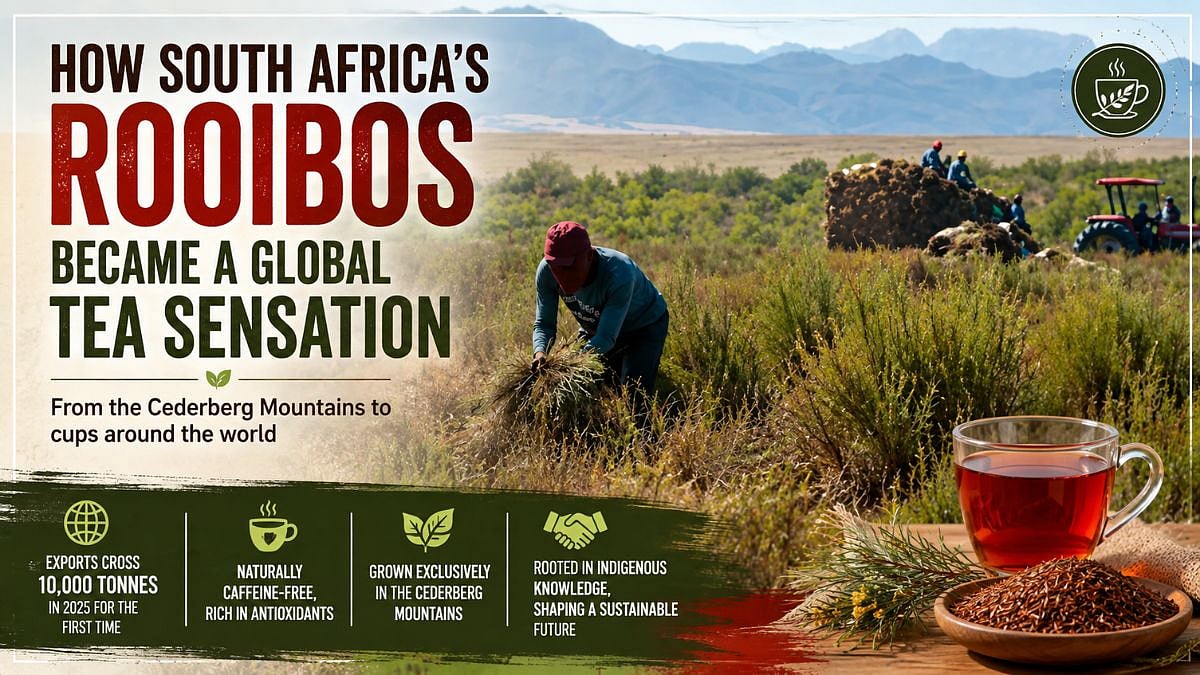
Cape Town, August 5, 2026: South Africa’s rugged Cederberg Mountains may be known for dramatic rock formations and wildlife such as baboons and leopards, but the arid region is also home to a plant that has quietly built a global following. Rooibos, which means “red bush” in Afrikaans, grows exclusively in a 60,000-hectare area of the Cederberg region, around 155 miles north of Cape Town.
Its needle-like leaves have long been used by South Africa’s Indigenous communities to make a woody-flavoured tea. Today, rooibos has travelled far beyond its native landscape. Global consumption rose 12.5 per cent between 2022 and 2024, while exports crossed 10,000 tonnes for the first time in 2025, compared with about 5,900 tonnes in 2015.
From Local Brew To Global Cup
“In the beginning, (rooibos) was virtually unknown, so the growth was just driven by more people getting to know it and enjoying its flavour,” said Martin Bergh, Managing Director of South Africa-based Rooibos Limited, the world’s oldest and largest rooibos processor.
The next phase of growth appears increasingly linked to health-conscious consumers. Rooibos is naturally caffeine-free, allowing it to compete with everyday drinks such as black tea and coffee. While experts say more research is needed, the plant has also been associated with health benefits, including a reduced risk of cardiovascular disease and cancer, because of its high levels of antioxidants and polyphenols.
Established in 1954 as the Rooibos Tea Control Board and later privatised, Rooibos Limited exports 400 million rand ($24.17 million) worth of rooibos annually to more than 50 countries. It accounts for almost half of South Africa’s total exports of the plant. The company buys and processes rooibos from farmers before selling it in bulk to international packers and brands, including Tick Tock, Tetley and Twinings.
Different Markets Different Tastes
Tea bags remain by far the biggest market, but tastes vary across countries. Unflavoured rooibos is popular in South Africa, Japan and the UK, while varieties infused with fruits and herbs are more popular in Europe and the US.
Germany helped start the international rooibos boom, but Japan has since become Rooibos Limited’s largest export market. The shift reflects a wider industry trend: Japan accounted for 33 per cent of South Africa’s rooibos exports in 2025. Bergh said newer offerings, including skincare products containing rooibos, are also helping drive Japanese demand.
That expansion shows how rooibos is moving beyond its identity as simply another tea. Its appeal across drinks, flavoured products and skincare could give the industry more ways to grow, particularly when consumer preferences differ sharply from one country to another.
Growth Built On Indigenous Roots
The success story, however, has a difficult history. Indigenous San and Khoi peoples harvested wild rooibos long before European settlers began cultivating it in the 1930s. White-owned companies benefited from years of subsidies and protection under the apartheid government, while Indigenous rooibos farmers were excluded from the industry.
In 2011, the South African San Council approached the government over the lack of recognition for the community’s traditional knowledge of rooibos. Government-commissioned research supported its claims. After lengthy negotiations, a benefit-sharing agreement was reached in 2019 between the rooibos industry and representatives of the San and Khoi people. It made it a legal requirement for companies in the industry to pay Indigenous traditional knowledge holders an annual levy.
Questions over inequality have not disappeared. Critics have argued that the agreement does not go far enough to address racial imbalances in land ownership. A 2017 study found that Indigenous communities controlled less than 7 per cent of rooibos-producing land and produced only 2 per cent of South Africa’s rooibos tea.
Rooibos Limited was among the agreement’s signatories. Bergh described the commercial industry’s contribution as “very fair”, while saying land distribution was the responsibility of the state. He said the company buys rooibos from farmers regardless of their background and that small-scale farmers, who tend to be farmers of colour, can find opportunities in niche markets seeking teas associated with particular producers, CNN reported.
Protected Name Boosts Exports
Another important milestone arrived in 2021, when years of industry lobbying resulted in rooibos receiving Protected Designation of Origin (PDO) status from the European Union. It became the first African product to receive the accreditation.
Only rooibos harvested and processed in designated areas of South Africa’s Western and Northern Cape can be labelled rooibos in EU markets. The protection puts the name in a category similar to Champagne and Gorgonzola cheese and guards against non-South African companies trying to claim exclusive rights over the Rooibos label.
For a product whose appeal is closely connected to where it comes from, that protection is particularly valuable. It gives South Africa a stronger claim over the identity of rooibos even as international demand increases.
“It opens up more opportunities to speak about the product (and) raise awareness,” said Marthane Swart, Secretariat of the South Africa Rooibos Council, a voluntary organisation whose members include Rooibos Limited. Swart believes the designation has contributed to exports.
Growth Faces New Challenges
Yet rooibos cannot simply expand wherever demand appears. The plant grows in a narrowly defined geographical area, making rapid growth a balancing act between commercial ambitions and environmental limits.
Production is highly sensitive to rainfall patterns and soil conditions. Over the past two decades, annual output has fluctuated between 13,000 and 25,000 tonnes. Reduced rainfall caused harvest volumes to fall 17 per cent in 2023, while production in 2025 was estimated to have been even lower.
Swart said the region is experiencing much drier summers and considerably less winter rainfall. At the same time, she noted that rooibos is naturally suited to dry conditions because it is essentially a wild plant that is now cultivated as a dry-land crop.
The plant also gives the industry an unusual advantage. Rooibos can be dried and stored without degrading, according to Bergh, allowing processors to build stocks during periods of high production and release them when harvests are weaker. Rooibos Limited effectively acts as a buffer, storing tea to maintain a steady supply to brands.
Trade And Climate Risks
Climate is not the only concern. Bergh sees geopolitical volatility as an even greater threat, pointing to sharply rising shipping costs out of Cape Town. The US imposed a 30 per cent tariff on South African goods last year, although the rate now stands at 12.5 per cent.
At the same time, new opportunities are emerging. Bergh described China as “the market with the biggest potential right now” after the country removed tariffs on agricultural imports from most African nations, including South Africa.
Rooibos has travelled an extraordinary distance without moving far from its roots. It can only be produced in a small part of South Africa, yet it has found consumers across the world. That exclusivity is both its greatest commercial strength and its biggest constraint.
Also Watch:
The industry must now manage rising demand while protecting the environment that makes rooibos possible, acknowledging the Indigenous knowledge behind it and navigating an increasingly unpredictable global trading system. Its next chapter will depend not merely on selling more tea, but on whether that growth can remain sustainable and equitable.
As Bergh put it: “Nothing’s ever static. We have to adapt.”
To get details on exclusive and budget-friendly property deals in Mumbai & surrounding regions, do visit: https://budgetproperties.in/

