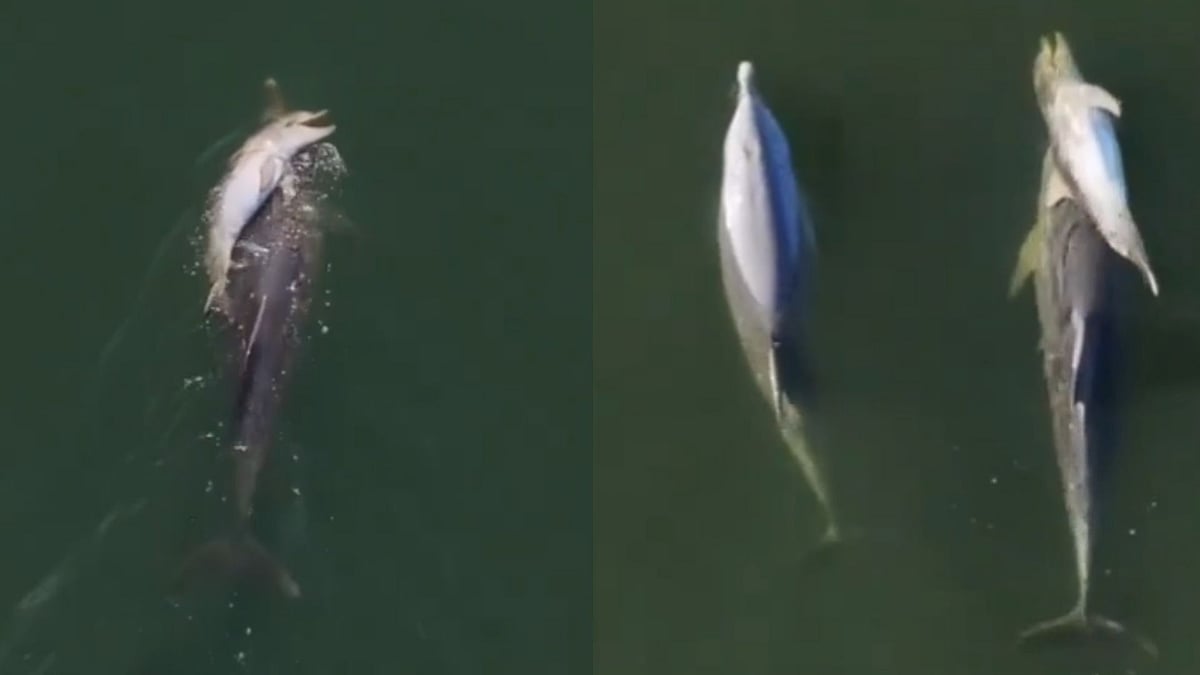
A deeply moving video of a bottlenose dolphin named Fraggle has touched millions online after she was filmed carrying the body of her dead calf through the waters of the Indian Ocean for nearly six days. The heartbreaking scene has reignited discussions about whether animals experience grief in ways that closely resemble human emotions.
The footage, captured by Australian conservation organisation Geographe Marine Research using a drone, shows Fraggle gently balancing her calf on her body as she continued swimming with her pod. The calf was estimated to be only two weeks old when it died.
A mother who had already endured repeated loss
Researchers familiar with Fraggle's history revealed that this was not the first time she had suffered the loss of a calf. According to the conservation team monitoring the dolphins, she had previously lost four calves, making this latest tragedy especially heartbreaking.
Scientists have observed that dolphin mothers often use their rostrum, head, or back to keep a deceased calf afloat, sometimes continuing the behavior for several days before eventually letting go.
The pod stayed close throughout the journey
One of the most touching moments captured in the footage was the behavior of the other dolphins in Fraggle's pod. Rather than leaving her behind, they remained nearby as she carried her calf, appearing to accompany her throughout the journey.
Marine biologists have documented similar behavior in several dolphin and whale species over the years. While researchers are cautious about assigning human emotions to animals, they agree that cetaceans display strong maternal bonds, complex social relationships, and behaviors that are widely considered consistent with mourning or grief-like responses.
Dolphins are among the most intelligent marine mammals, known for their advanced communication, long-term social connections, cooperation, and the ability to recognize themselves in mirrors-traits that highlight their sophisticated cognitive abilities.
Social media reacts to the heartbreaking scene
The emotional video quickly spread across social media, where thousands of viewers shared their thoughts on the remarkable display of maternal attachment.
“Reminder that animals have emotions and understand death,” wrote one user.
“And the pod aka community of dolphins did not leave by her side. They allowed her to have her space in the distant and still swam with her. Dolphins are amazing creatures,” added another.
“This is devastating to watch. It’s a powerful reminder that grief isn’t uniquely human,” commented a third user.
“I just discovered the other week that chicken mothers (hens) do the same thing, and just like that, I no longer could eat chicken,” a fourth person shared.
Animal grief continues to fascinate scientists
Cases of mothers carrying deceased offspring have been documented in dolphins, whales, elephants, and some primates. Although scientists continue to study the reasons behind this behavior, many believe it reflects the exceptionally strong bond between mothers and their young rather than simple instinct alone.

