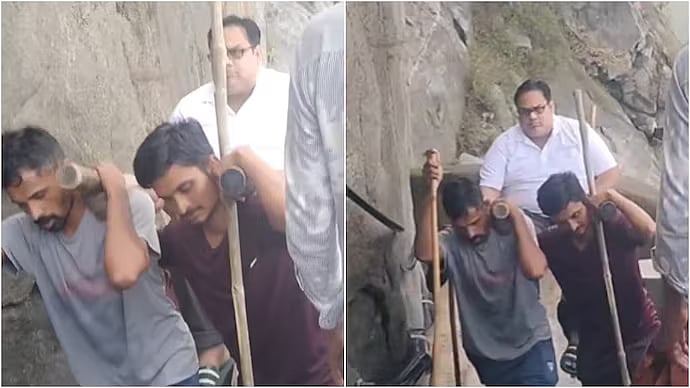
A video circulating widely on social media has reignited a long-standing debate over whether it is ethically acceptable for one person to be physically carried by others during religious pilgrimages. The clip, believed by many social media users to have been filmed on a pilgrimage route in Junagadh, has shifted public attention from the destination itself to the practice of human-powered palanquin services.
Although the exact location of the footage has not been officially confirmed, the discussion it has generated has spread far beyond the place where it was recorded.
Four men seen carrying devotee uphill
The viral footage shows a devotee seated on a makeshift palanquin while four men carefully carry him up a steep staircase leading toward a hilltop shrine. As they climb the narrow steps, the effort required to balance both the passenger and the structure is clearly visible.
The demanding nature of the work has prompted many viewers to question whether such practices still have a place in modern society.
Caption questions the ethics of the practice
The post accompanying the video directly challenged the idea of people carrying other people for transport. "Not sure how God would feel about this."
It also addressed a common defence of the practice by stating, "Please don't justify by saying, 'It's giving employment to four people.'"
The person who shared the video clarified that the criticism was not aimed at individuals who rely on the service because of age, illness, disability or other genuine medical reasons.
"I'm not commenting on anyone's physique; people may have genuine health conditions. It's the idea of humans carrying other humans," the caption read.
Social media divided over tradition and dignity
The clip quickly attracted thousands of reactions, with many users expressing discomfort over the sight of people earning a livelihood by carrying another person's weight. Several commenters argued that regardless of its historical roots, the practice appears inconsistent with modern ideas of equality and human dignity.
Some also questioned whether the service should continue at locations where ropeways, battery-operated vehicles or other transportation alternatives are available.
However, others urged people to consider the issue from multiple perspectives rather than making a blanket judgment.

