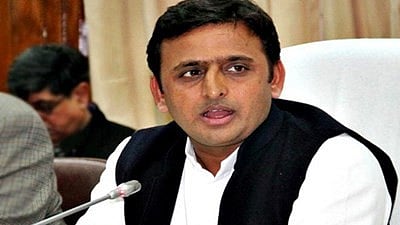
A dangerous political game appears to be unfolding in Uttar Pradesh. It may seem unusual, but the pattern is familiar. Whenever a major political development gathers momentum in the state, Samajwadi Party national president Akhilesh Yadav is often seen leaving for a foreign destination.
In other words, when the opposition's presence on the ground is needed the most, he is frequently away on what are described as 'private' overseas visits. This raises an obvious question: Is it merely a coincidence, or part of a larger strategy? From every angle, these trips appear to be far more than routine family vacations.
Political circles are abuzz with speculation that these are not simply personal visits but may serve a broader objective. India-opposed organizations remain active in countries such as the United Kingdom and the United States, with allegations that some of them support campaigns aimed at creating instability. Questions are now being raised over whether foreign backing is being sought ahead of the 2027 Uttar Pradesh Assembly elections.
Seeking external political support, especially from forces accused of interfering in democratic processes, would naturally raise serious concerns. What, then, is the real purpose behind these repeated foreign visits? Are there any links to foreign propaganda networks? Could external actors interested in influencing India's political landscape be involved? These are the questions currently being discussed in political circles.
Timing of foreign visits raises eyebrows.
Akhilesh Yadav's record shows that overseas trips during politically sensitive periods are not new. Although the Samajwadi Party consistently describes them as private visits, their timing has often attracted attention.
In June 2018, he traveled abroad with his family at a time when the SP was attempting to unite opposition parties, and the controversy surrounding damage to the government bungalow in Lucknow was dominating headlines. His decision to leave the country during that period drew criticism.
A similar situation emerged during the 2020 Hathras incident, one of the country's biggest political issues at the time. While opposition leaders rushed to Hathras, Akhilesh Yadav was reportedly abroad.
The pattern resurfaced in 2025. After the SP's improved performance in the 2024 Lok Sabha elections, many expected him to aggressively challenge the government during the 2025 Budget Session. Instead, he traveled to London with his family. Critics argued that while political battles were being fought at home, he chose to spend time overseas rather than strengthen the party organization, address state issues or respond to allegations against him.
Akhilesh Yadav is known to have traveled extensively, including visits to Australia, the United States, the United Kingdom, China, Switzerland, France, Austria, Canada and Japan.
Why does Akhilesh rely so heavily on Western narratives?
Akhilesh Yadav frequently cites foreign media reports during his press conferences, particularly those published by the BBC. His repeated references create the impression that BBC reports are treated as highly authoritative.
However, critics argue that the BBC has long faced accusations of carrying a colonial mindset and presenting India through a Western lens. Its reporting on issues such as Kashmir and human rights has often been criticized by sections of the Indian establishment as one-sided. The Government of India also described the BBC documentary India: The Modi Question as hostile propaganda.
The same criticism, according to BJP supporters, extends to the BBC's reporting on Uttar Pradesh. They allege that the broadcaster portrayed events such as the Maha Kumbh negatively, questioned waste management arrangements and raised concerns over the purity of the Triveni bathing waters, reflecting what they describe as a pattern of selective reporting.
According to critics, Akhilesh Yadav has consistently highlighted such reports in his political attacks. Whether the issue concerns the Maha Kumbh or, more recently, allegations related to donations at the Ram Temple, BBC reports have frequently featured prominently in his public statements.
How neutral are institutions like the BBC?
While Akhilesh Yadav has often accused sections of the Indian media of bias, critics argue that the BBC itself has repeatedly faced allegations of partiality.
Within the UK and Europe, the broadcaster has frequently been criticized for having a liberal or left-leaning editorial outlook. Questions have also been raised regarding newsroom culture, staffing and editorial orientation.
Critics further cite controversies involving BBC reporting on former US President Donald Trump, where allegations of factual inaccuracies and editorial lapses sparked widespread debate. Such controversies, they argue, make Akhilesh Yadav's reliance on BBC reports particularly noteworthy.
This has led political opponents to question why foreign media organizations appear to enjoy greater credibility in his political messaging than many domestic sources. They also ask whether such reliance reflects the influence of a broader foreign political narrative.
Also Watch:
Is Akhilesh following Rahul Gandhi's political playbook?
Observers drawing parallels point to Congress MP Rahul Gandhi's pattern of overseas visits. Rahul Gandhi, a key INDIA bloc leader and political ally of Akhilesh Yadav, has also undertaken several foreign tours in recent years. Most recently, he returned from a 20-day visit covering London, Germany and Finland, a trip that remained largely private.
Earlier, during his September 2024 visit to the United States, Rahul Gandhi met US Congresswoman Ilhan Omar, who has often been criticized in India for her views on Indian affairs. Political commentators have also referred to reports alleging meetings in Europe involving individuals said to be associated with networks linked to George Soros, who has faced accusations from BJP leaders of attempting to influence democratic processes in India.
Supporters of the BJP argue that when Indian political leaders interact with individuals or organizations accused of advocating political change in India, such meetings inevitably invite scrutiny. Against this backdrop, Akhilesh Yadav's current overseas visits are also being viewed through a similar lens by his critics.
'Such Strategies will not work in Uttar Pradesh'
Political discussions have increasingly centered on whether Akhilesh Yadav is adopting a similar approach by relying on foreign narratives and whether attempts are being made to influence the 2027 Uttar Pradesh elections through overseas funding or propaganda.
Recently, Suheldev Bharatiya Samaj Party chief and Uttar Pradesh Panchayati Raj Minister Om Prakash Rajbhar also raised similar questions. He claimed that discussions were taking place suggesting that Akhilesh Yadav had hired a foreign agency to assist with election-related work.
Rajbhar advised Akhilesh not to depend on foreign entities, arguing that such strategies would neither guarantee electoral success nor justify the expenditure involved. He remarked that if foreign funding alone could win elections, leaders such as Rahul Gandhi and Arvind Kejriwal would not have faced political setbacks.
According to critics, if Akhilesh Yadav follows what they describe as Rahul Gandhi's political approach, it could reinforce the perception that he lacks confidence in fighting political battles on the ground.
Ultimately, they argue that the people of Uttar Pradesh are politically aware and unlikely to be influenced by what they describe as foreign-backed narratives or propaganda.
By Pramod Diwakar

