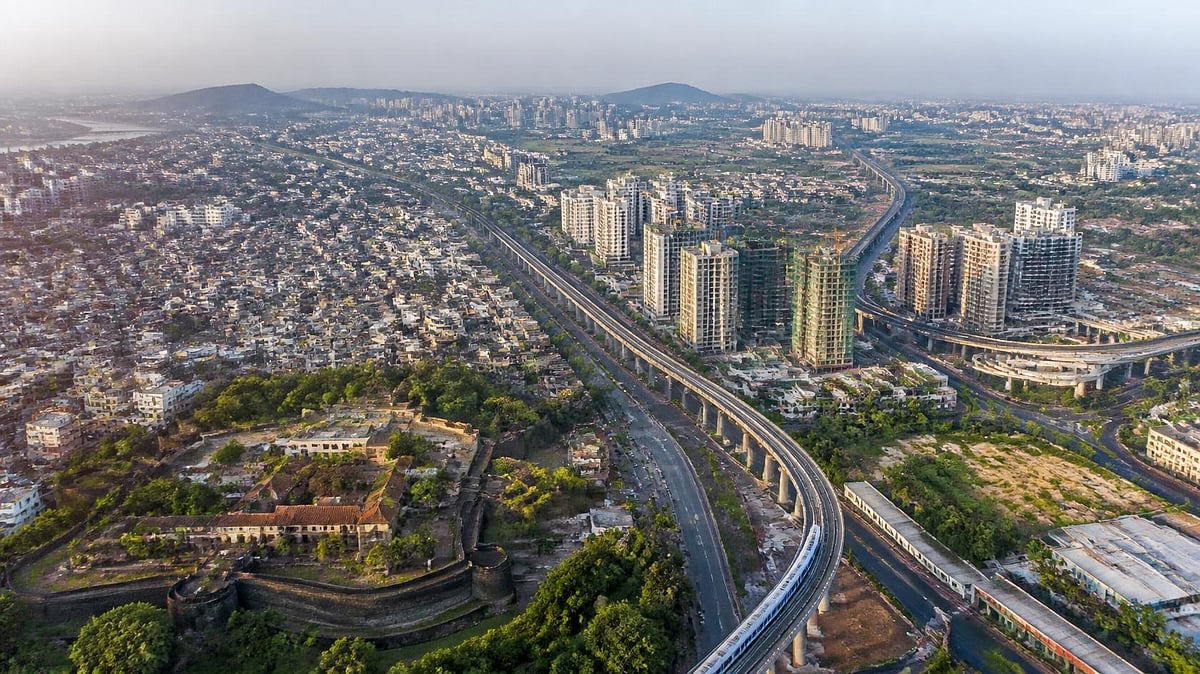
Pune: Before Pune became one of India's fastest-growing real estate markets, it was a city defined by its historic core. The bustling Peth areas, Shivajinagar, Deccan, Camp and a handful of established neighbourhoods represented the city's economic and residential heart. Over the decades, however, Pune has repeatedly expanded beyond what many believed were its natural limits. Every generation has witnessed a new frontier of growth, transforming villages into thriving urban centres and expanding the city's footprint.
Today, another transformation is quietly unfolding. The next chapter in Pune's real estate story is no longer confined to the city's municipal boundaries. It is increasingly being shaped by regional connectivity, infrastructure and the emergence of a larger metropolitan economy that stretches far beyond the traditional definition of Pune.
From a compact city to a metropolitan region
Pune's growth has always followed a predictable pattern. As the city expanded, new residential and commercial centres emerged on its outskirts before eventually becoming an inseparable part of the urban landscape.
Areas such as Kothrud, Aundh, Baner, Hadapsar and Kondhwa were once considered distant suburbs. Over time, improved roads, educational institutions, commercial development and employment opportunities transformed them into some of Pune's most sought-after neighbourhoods.
The next wave of expansion shifted even further outward. Hinjawadi emerged as the country's leading IT destination, while Wakad, Balewadi, Punawale, Tathawade, Kharadi, Wagholi and large parts of Pimpri-Chinchwad evolved into major residential and commercial hubs. Today, these locations are no longer viewed as the city's outskirts. They have become integral to Pune's everyday life, housing lakhs of residents and thousands of businesses.
This continuous outward movement illustrates an important reality about urban development: cities rarely stop growing simply because they reach administrative boundaries. Instead, they evolve wherever infrastructure, employment and connectivity create new opportunities.
Infrastructure is changing the geography of growth
The next phase of expansion is being driven by infrastructure on a scale that Pune has rarely witnessed before.
Metro rail corridors continue to extend public transport across the city. Ring roads proposed by the Pune Metropolitan Region Development Authority (PMRDA) promise to redistribute traffic while opening entirely new development corridors. Highway upgrades, new bridges and improved arterial roads are steadily reducing travel time between locations that once appeared disconnected.
Projects undertaken by Pune Municipal Corporation (PMC), Pimpri-Chinchwad Municipal Corporation (PCMC), PMRDA and the National Highways Authority of India (NHAI) are collectively reshaping how people move across the region.
In real estate, travel time often matters more than physical distance.
A locality that once required an hour to reach may suddenly become attractive if new infrastructure reduces the commute to 25 minutes. Developers recognise this shift long before buyers fully appreciate it, which is why investment frequently arrives ahead of large-scale population movement.
This explains why several areas beyond Pune's traditional growth corridors are now witnessing increasing residential and commercial interest.
Buyers are looking beyond traditional locations
Market conditions also reflect this changing geography.
Although housing sales have moderated compared to previous years, property prices have remained relatively stable. Buyers are taking longer to make purchasing decisions, yet demand continues to exist, particularly in locations supported by upcoming infrastructure.
Today's homebuyers are evaluating far more than the apartment itself. Connectivity to workplaces, educational institutions, healthcare facilities, public transport and future infrastructure has become central to purchase decisions.
Developers, too, are responding accordingly. Instead of concentrating solely within established micro-markets, many are acquiring land across the wider Pune Metropolitan Region, anticipating future demand.
The search for larger homes, better amenities and comparatively affordable prices is gradually encouraging buyers to consider locations that would have been dismissed a decade ago.
Pune and Pimpri-Chinchwad already function as one city
Administrative maps continue to show Pune and Pimpri-Chinchwad as separate municipal corporations. In reality, however, the distinction has become increasingly blurred.
Lakhs of people commute daily between the two cities for work, education and business. IT parks, manufacturing units, hospitals, shopping centres and educational institutions operate seamlessly across both jurisdictions.
For residents, the boundary often exists only on paper.
This integration mirrors the evolution witnessed in several other metropolitan regions across India, where multiple municipalities gradually became part of a single economic ecosystem.
Pune and Pimpri-Chinchwad have already reached that stage.
The next phase could see this integrated urban region extend even further into surrounding growth corridors.
Lessons from Mumbai's metropolitan expansion
Mumbai offers perhaps the closest example of how metropolitan regions evolve over time.
There was a period when Mumbai, Navi Mumbai and Thane were viewed as entirely separate urban centres. Today, they function as one interconnected economic region, linked through highways, suburban rail, metro networks and commercial activity.
People routinely live in one city, work in another and access education, healthcare and entertainment across the metropolitan region.
Pune appears to be moving along a similar path, although at its own pace and with its own unique characteristics.
Improved connectivity between Pune and Mumbai through the Mumbai-Pune Expressway, the Missing Link project and future transport initiatives is steadily reducing travel time between the two cities.
While they will remain distinct urban centres with their own identities, stronger regional connectivity could significantly reshape investment patterns across western Maharashtra.
Opportunities must be matched by planning
However, infrastructure alone cannot guarantee sustainable urban growth.
Rapid expansion also places enormous pressure on water resources, transport systems, waste management, affordable housing and environmental sustainability.
Without careful planning, unchecked development can create congestion, strain civic infrastructure and reduce the quality of life that initially attracted people to these emerging locations.
The success of Pune's next growth phase will therefore depend not only on roads and metro lines but also on coordinated planning between civic bodies, sustainable land use, environmental conservation and timely delivery of public services.
Balanced development will be essential if the region is to avoid repeating challenges already experienced by many rapidly growing Indian cities.

