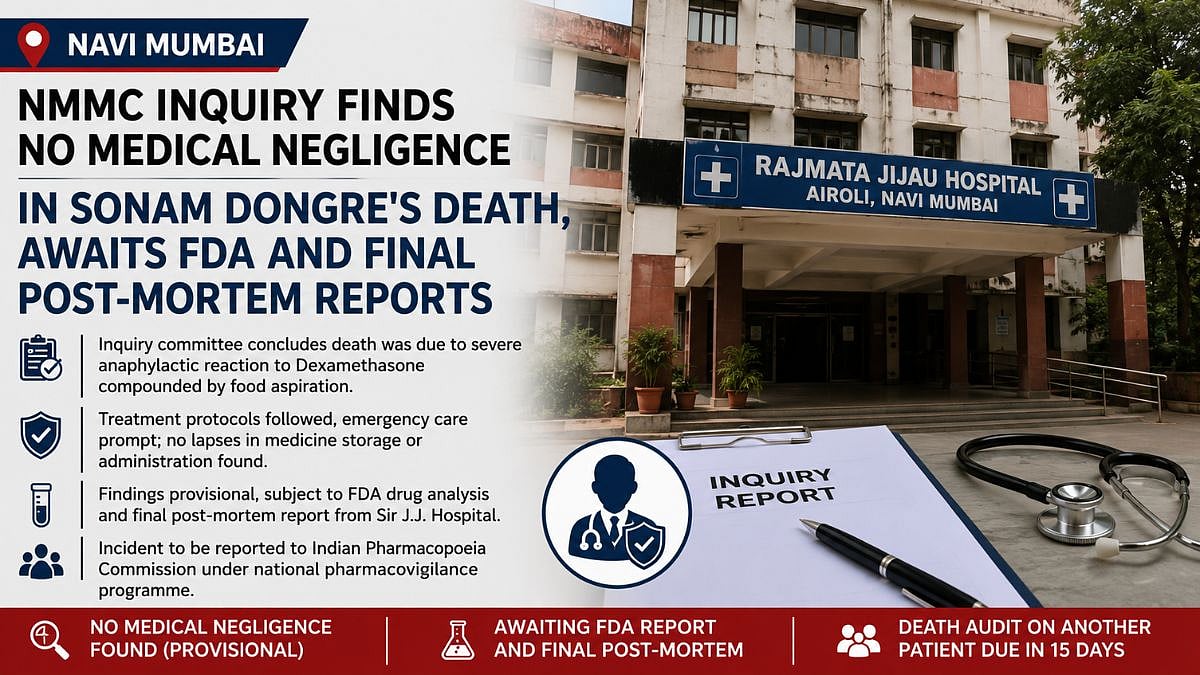
Navi Mumbai, July 20, 2026: A high-level inquiry committee constituted by the Navi Mumbai Municipal Corporation (NMMC) has concluded that there was no medical negligence in the death of 30-year-old Sonam Dongre at Rajmata Jijau Hospital, Airoli, attributing her death to a severe anaphylactic reaction to an injection of Dexamethasone, compounded by food aspiration.
However, the committee has clarified that its findings are preliminary and could change after the Food and Drug Administration (FDA) submits its report on the drug and Sir J.J. Hospital issues the final post-mortem report.
The report, presented before the NMMC General Body on Monday, was prepared by an expert committee headed by Thane Civil Surgeon Dr Kailash Pawar.
The panel included specialists from Sir J.J. Hospital, the Navi Mumbai Obstetrics and Gynaecology Society (NMOGS), forensic medicine, pharmacology, anaesthesiology and the NMMC's Medical Health Department.
Committee Reviews Hospital Records
The committee visited Rajmata Jijau Hospital on July 8, where it interviewed all doctors, staff nurses, the sister-in-charge, matron and the medical superintendent. Their statements were recorded and signed, while the labour room where the incident occurred was inspected.
The panel also examined treatment records, indoor patient files, medicine stock, storage practices, used ampoules and vials, and the provisional post-mortem report from Sir J.J. Hospital.
According to the report, Sonam Dongre had been administered a second intramuscular dose of Inj. Dexamethasone 12 mg, while another patient, Richa Mishra, received Inj. Dexamethasone 12 mg along with Inj. Isoxsuprine HCL 10 mg. Both doses were administered 24 hours after the first dose as part of the standard protocol for managing threatened preterm labour.
The committee found that the dosage, route of administration and timing of the injections strictly adhered to accepted medical protocols. It also observed that the nursing staff had verified the correct medicine, dose and route before administration.
The report noted that immediately after the adverse reactions were identified, the doctors and nursing staff initiated resuscitation measures without delay.
The attending gynaecologist, who was present in the labour room, began emergency treatment immediately, while an anaesthesiologist was summoned to assist in resuscitating both patients simultaneously. The panel concluded that the treating doctors remained vigilant throughout the emergency and took all necessary steps.
The committee also ruled out lapses in medicine storage and inventory management. During its inspection of the labour room, all drug storage points were examined and no discrepancies or gaps were found.
It further opened and examined the sealed packet containing the used medicine vials and ampoules, verified their expiry dates and confirmed that the correct medicines had been administered.
Findings On Adverse Drug Reactions
The provisional post-mortem report from Sir J.J. Hospital, received on July 8, recorded laryngeal oedema and petechial haemorrhages in the lungs, heart and brain—findings suggestive of an anaphylactic reaction. It also noted that there were no pre-existing pathological conditions or significant lesions in the body.
The committee stated that Richa Mishra developed severe hypotension, a known side effect of Isoxsuprine, but was successfully revived through haemodynamic correction and temporary ventilatory support. She was later referred to Fortis Hospital, where she recovered and is now stable.
In Sonam Dongre's case, the report stated that she suffered a severe adverse drug reaction to Dexamethasone. Her condition deteriorated further due to food aspiration into the airway, leading to severe bronchospasm and respiratory complications. Despite timely resuscitation and standard treatment, she could not be revived and succumbed to the reaction.
The panel also reviewed the case of Pratima Pal, who had received the same treatment on July 1 for threatened preterm labour. She developed mild hypotension and restlessness following the administration of Isoxsuprine, which were corrected with intravenous fluids. She was shifted to Sir J.J. Hospital in a stable condition and discharged on July 7.
The committee said it reviewed available scientific literature on anaphylaxis following Dexamethasone administration and found documented case reports, including one involving a fatal reaction after the drug.
Based on its findings, it concluded that Pratima Pal experienced a mild adverse reaction, Richa Mishra a moderate reaction, while Sonam Dongre suffered a severe anaphylactic reaction complicated by food aspiration, resulting in her death.
Recommendations And Pending Reports
The committee recommended that the incident be reported to the Indian Pharmacopoeia Commission, Ghaziabad, under the Pharmacovigilance Programme of India (PvPI), as it qualifies as a severe adverse drug reaction requiring national reporting.
It also noted that the report remains provisional and is subject to revision after the FDA submits its findings on the drug samples and Sir J.J. Hospital issues the final cause-of-death report.
"The committee found that the medicines were administered as per standard treatment protocols, emergency management was prompt and appropriate, and no medical negligence was observed. However, the final opinion will depend on the pending FDA analysis and final post-mortem findings," said an NMMC official.
Also Watch:
The inquiry committee is also expected to submit, within the next 15 days, a separate death audit report into the death of Pratiksha Uday Khandekar, who died at the same hospital on March 17, as directed by the NMMC Commissioner.
To get details on exclusive and budget-friendly property deals in Mumbai & surrounding regions, do visit: https://budgetproperties.in/

