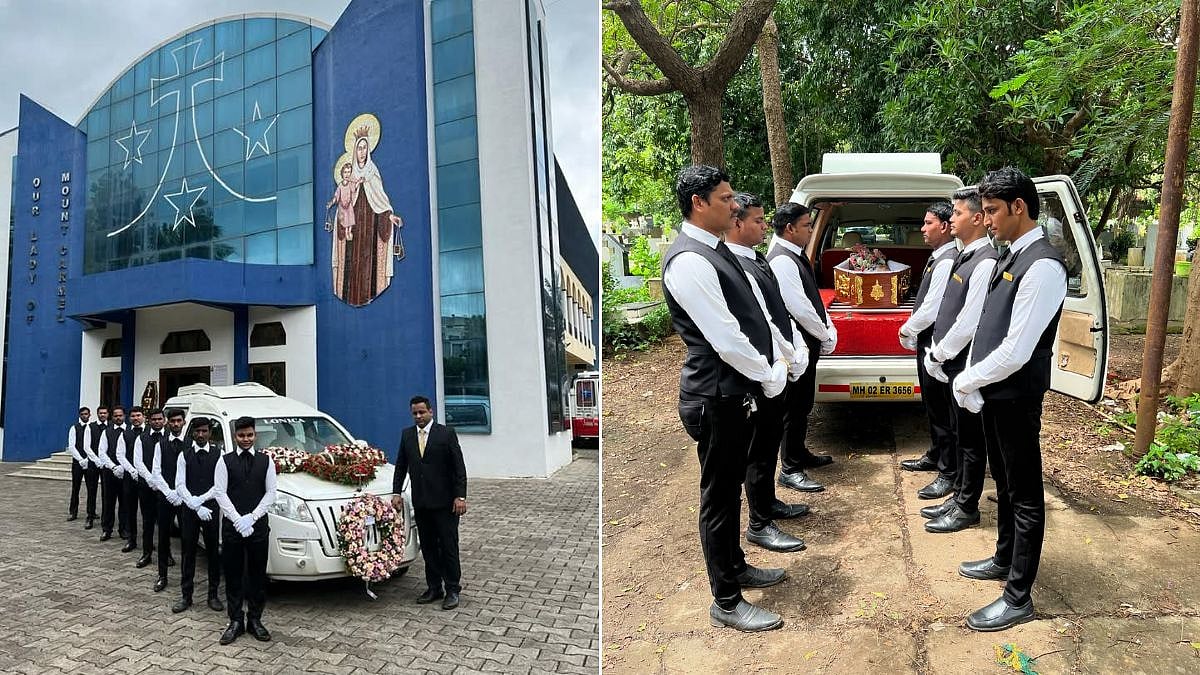
Mumbai: Long regarded as the traditional final rite in Christian communities, burial is steadily giving way to cremation among Mumbai's Roman Catholics. The shift reflects a broader trend seen across the West, but in the city it is being driven largely by practical concerns, including a severe shortage of cemetery space, the rising cost of maintaining graves, and changing family circumstances.
Church leaders and funeral service providers say requests for cremation have increased significantly over the past two decades, prompting a gradual rethinking of long-held funeral customs while remaining within the framework of Catholic teaching.

Father Joseph D'Souza, Parish Priest of the Church of Our Lady of Health in Kalbadevi, who has served in several Roman Catholic parishes across Mumbai, said that around 10 out of every 100 Catholic funerals now culminate in cremation. Two decades ago, the figure was only one or two in every 100.
"Many people find conditions in some burial grounds unhygienic. Rat and pest infestations around graves are a concern," said Father D'Souza.
Sunil Colaco, proprietor of Lonica Undertakers, which operates branches across Mumbai, said the change has become increasingly evident in recent years.
"Ten years ago, cremations were rare. Now I oversee at least one cremation every week," he said, after arranging a funeral service followed by cremation in Santacruz on Friday morning.
According to Colaco, the trend is particularly pronounced in areas such as Bandra, where many Catholic families have relatives settled abroad.
"In many cases, the children or close family members of the deceased live overseas. They have seen that cremation is widely accepted in Western countries and prefer to take the ashes with them rather than maintain a grave in Mumbai that they cannot regularly visit," he said.
He added that the ashes can either be placed in a columbarium niche or preserved in an urn at home, making them easier for families to care for than a burial plot.
Father D'Souza said the example set by members of the Society of Jesus (Jesuits), which runs St Xavier's College, also helped normalise cremation after some Jesuit priests chose to be cremated.
Father Nigel Barrett, spokesperson for the Archdiocese of Bombay and Parish Priest of St Andrew's Church, Bandra, emphasised that the Catholic Church permits cremation.
"Catholic teaching is that cremation is permitted, and it is not, in itself, a denial of Christian doctrine, because the Church believes that God can raise the deceased to new life and that the soul's destiny is not affected," he said.
However, Father Barrett stressed that the Church continues to regard burial as the preferred practice.
"At the same time, the Church strongly prefers burial and asks Catholics to avoid choosing cremation for reasons contrary to the Christian faith, while ensuring that the mortal remains are treated with appropriate reverence," he added.
Despite opting for cremation, most Catholic families continue to follow traditional funeral rituals. The deceased is brought home for relatives and friends to pay their respects before a funeral Mass is held in church.
"Families usually purchase a coffin for the church service and then donate it back to the undertaker before the cremation takes place. The coffins are subsequently provided to poorer families who cannot afford one," Colaco said.
Father D'Souza noted that most Catholic families opting for cremation choose electric crematoriums, reflecting prevailing practices in many Western countries.

Colaco said an increasing number of people are also expressing their preference for cremation well before their death.
"Many individuals now tell their families in advance that they wish to be cremated," he said.
He recalled one particularly unusual case involving a Muslim woman who had specifically instructed her husband that she wanted to be cremated.
"She had made her wishes very clear before her death. It was an exceptional case because Muslims rarely choose cremation," Colaco said.
To get details on exclusive and budget-friendly property deals in Mumbai & surrounding regions, do visit: https://budgetproperties.in/

