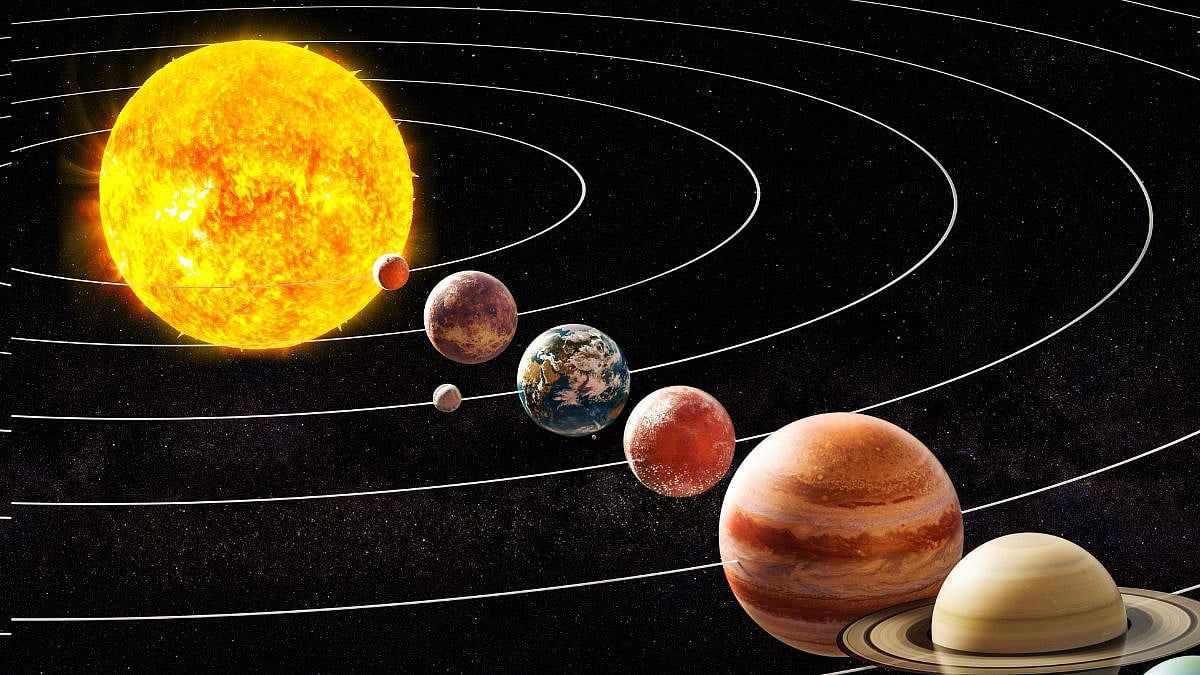
One of the rarest celestial events is set to occur in August 2026, where six planets will align, including Jupiter, Mercury, Mars, Uranus, Saturn and Neptune. The celestial event will occur in the early morning, before sunrise. In this rare celestial event, these planets from our solar system will be visible; it is also known as a planetary parade. Skywatchers will get a chance to witness the phenomenal display of planets, while the planets won't form a perfect straight line in space, they appear to be grouped together from our perspective on the blue planet, Earth.
Planetary alignment to occur in August 2026
The six planets of our Solar System, including Jupiter, Mercury, Mars, Uranus, Saturn and Neptune, are set to appear in the morning sky in the early morning before sunrise. But all the planets will not be easy to watch through naked eye. Mars and Saturn will likely be seen clearly through naked eyes, Mercury will be low but possible to catch with a clear horizon, Jupiter will sit even lower than Mercury and to watch Uranus, binoculars are required, meanwhile to watch Neptune will be needed. The main date of the alignment is August 12 but best practical viewing time depends upon locations. In some cities, the best time could fall on August 11, 12 or 13, 2026 because Mercury and Jupiter rise very close to sunrise.
What is planetary parade?
A planetary parade refers to an event when multiple planets align in the night sky, also known as a planetary alignment. This phenomenon occurs because the planets orbit the Sun at different speeds. At certain points in their orbits, they line up from our perspective on Earth.
While planetary alignments are not extremely rare, they do not occur every year. The planets move slowly, and when all seven planets can be seen lined up, it becomes a particularly rare event.
Visibility of celestial event in India
The upcoming celestial event is set to be witnessed in India. The best viewing window is in the pre-dawn hours between 4:30 AM to 5:30 AM, looking towards the east and north-east horizon, right before sunrise. Monsoon clouds in August may obstruct views in many areas, so open or dry regions offer the best results. You can track precise planetary positions using applications.

