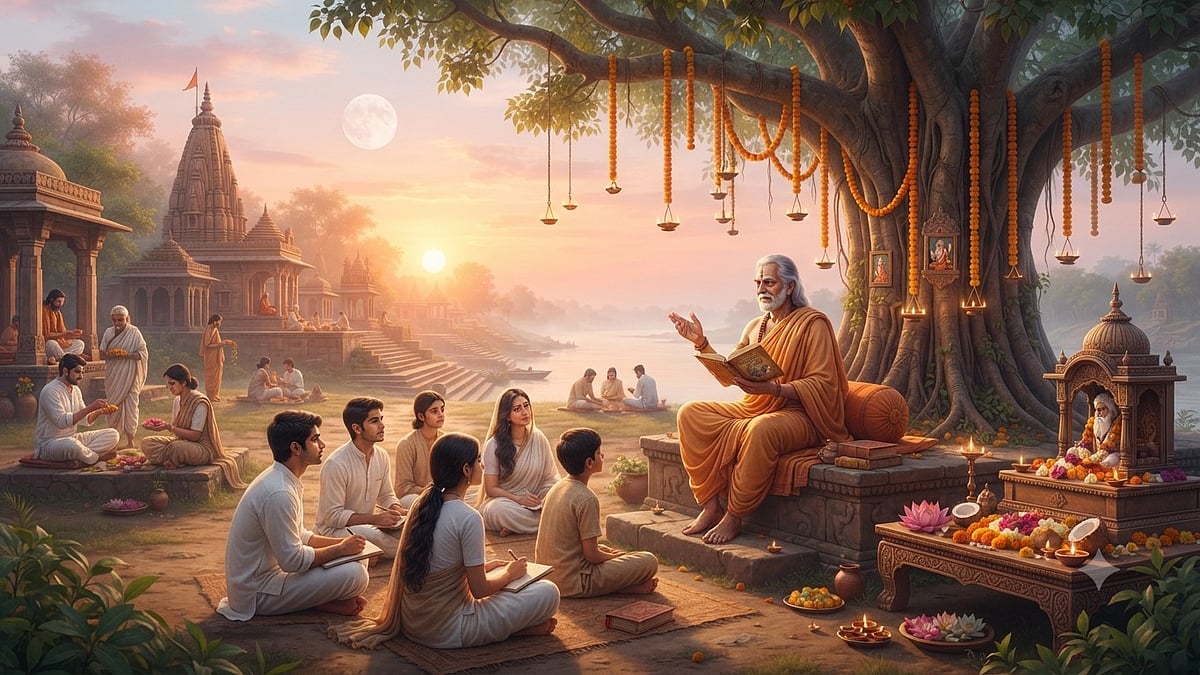
Who has shaped your life the most? A parent who believed in you, a teacher who inspired you, a coach who pushed you beyond your limits or a mentor who showed you possibilities you never imagined? Behind every successful person stands someone who lit the way.
This is the spirit of Guru Purnima—a day dedicated to honouring those who remove the darkness of ignorance and awaken the light of knowledge.
For thousands of years, India's greatest strength has not been its wealth or military power, but its guru–śiṣya paramparā—the timeless mentor-disciple lineage. It is this unbroken chain of wisdom that has preserved the profound science of self-management from generation to generation.
A guru does far more than give information. A guru transforms lives.
The word guru itself means "the remover of darkness." The darkness of ignorance—of our true nature, our purpose and our immense inner potential. The guru helps us discover who we truly are, teaches us how to live successfully in the world and ultimately how to rise above its limitations.
Guru Purnima is therefore much more than a festival. It is an opportunity to commit ourselves to growth, excellence and inner evolution.
Vedanta transforms us into rajarishis—people who are dynamic and successful in the world while remaining calm, wise and fulfilled within. Without this inner wisdom, even material success eludes us.
No one achieves greatness alone. An athlete needs a coach. A musician needs a mentor. A scientist needs a guide. Likewise, on the spiritual journey, the guru shows the way to Enlightenment.
Indian culture therefore places the teacher on the highest pedestal. The guru is revered because he not only understands the Truth but also possesses the skill to communicate it. Such a teacher is both Brahmavit—established in the knowledge of the Absolute—and Brahmajña—capable of guiding others towards that same goal.
India has been blessed with extraordinary sages in every generation. They have preserved this sacred tradition despite changing times and circumstances. Guru Purnima is our opportunity to express gratitude for this remarkable legacy and resolve to keep it alive.
But the responsibility does not rest with the teacher alone. The student has an equally important role.
The Bhagavad Gita describes three essential qualities of an ideal seeker.
The first is pranipāta—humility and openness to learning. This is not blind obedience. The second is praśna—the courage to question. The third is sevā—selfless service. Service purifies the mind and prepares it to absorb higher knowledge.
Guru Purnima is also celebrated as Vyasa Purnima, in recognition of the vital role played by Vyasa in the preservation of Vedanta. Vyasa was one of the greatest minds in human history. Every platform from which Vedanta is taught is called the Vyasapeetha, acknowledging his invaluable contribution. Teachers offer their respects to Vyasa before beginning their discourses.
Born to Sage Parāśara and Satyavati on the full moon day of the month of Āṣāḍha, Vyasa beautifully combined profound spiritual wisdom with remarkable practicality. The word Purnima means fullness and illumination, symbolising the spiritual Enlightenment that Vyasa achieved.
Vyasa’s contribution to Indian thought is unparalleled. He organised the Vedas, composed the Brahma Sutras, authored the Puranas and gave the world the Mahabharata—the world's longest epic, containing nearly one hundred thousand verses and the immortal wisdom of the Bhagavad Gita.
A delightful story surrounds its composition. Lord Ganesha agreed to write the Mahabharata on one condition—that Vyasa would dictate continuously without pause. Vyasa accepted but insisted that Ganesha must first understand every verse before writing it down. Whenever Vyasa needed a moment to think, he would compose an especially profound verse, giving him the brief but welcome respite.
The Mahabharata is not only a work of art, poetic excellence and entertainment but has inspired generations of Indians through the ages with its useful instructions on life and the immortal message of the Bhagavad Gita.
Oliver Goldsmith's famous lines seem especially fitting:
"And still they gazed, and still the wonder grew,
That one small head could carry all he knew."
On this sacred day, we bow in gratitude to Sage Vyasa, to our own teachers and to the entire guru–śiṣya tradition.
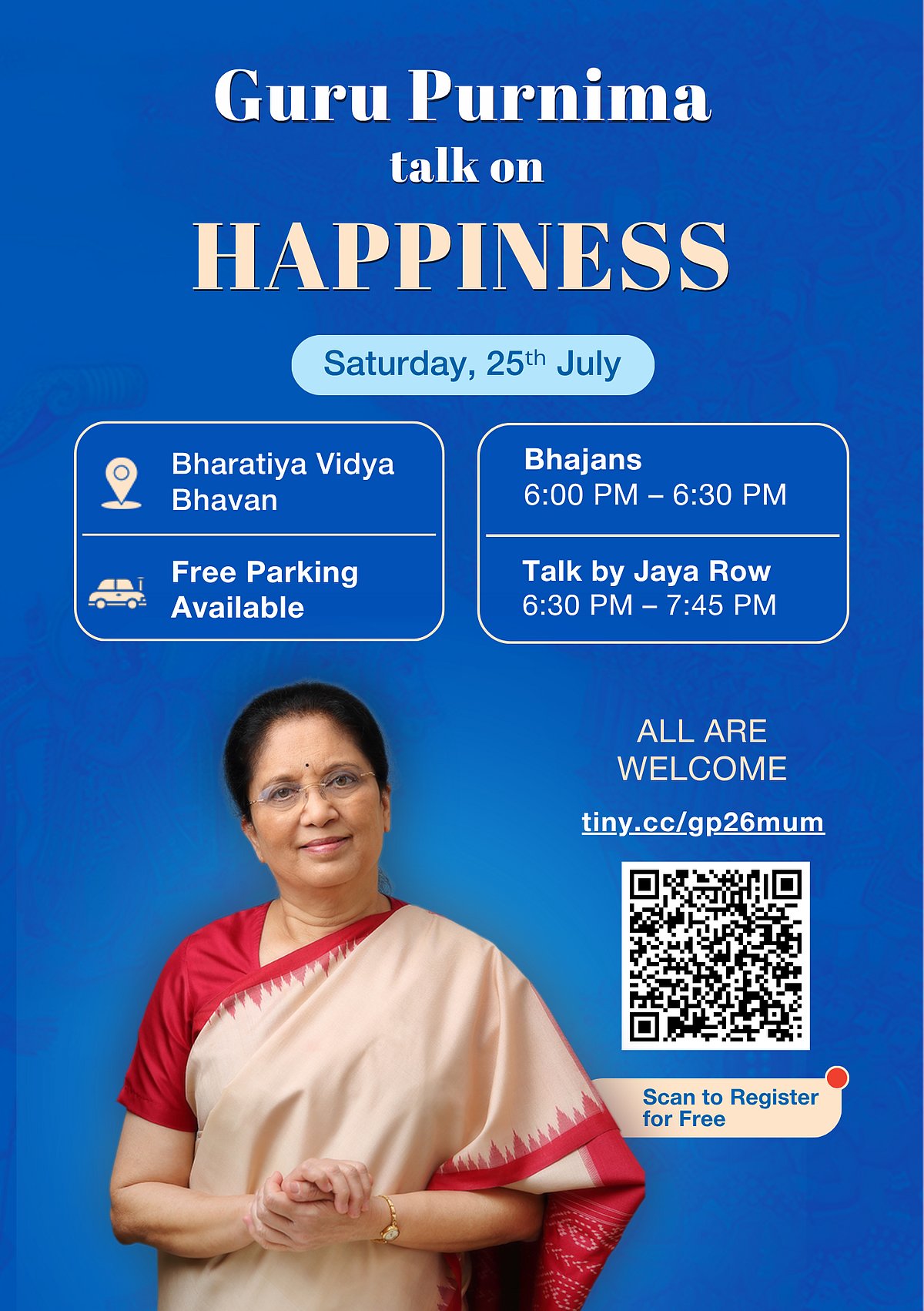
(Guru Purnima talk on HAPPINESS by Jaya Row on 25 July at 6 pm at Bharatiya Vidya Bhavan, Mumbai 400007. All are welcome. WhatsApp 99200 54000 for queries.)

