The echoes of the jaat—the twin-layered stone mill—break the pre-dawn silence in rural Maharashtra long before the Bharadwaj bird calls through the sugarcane fields.
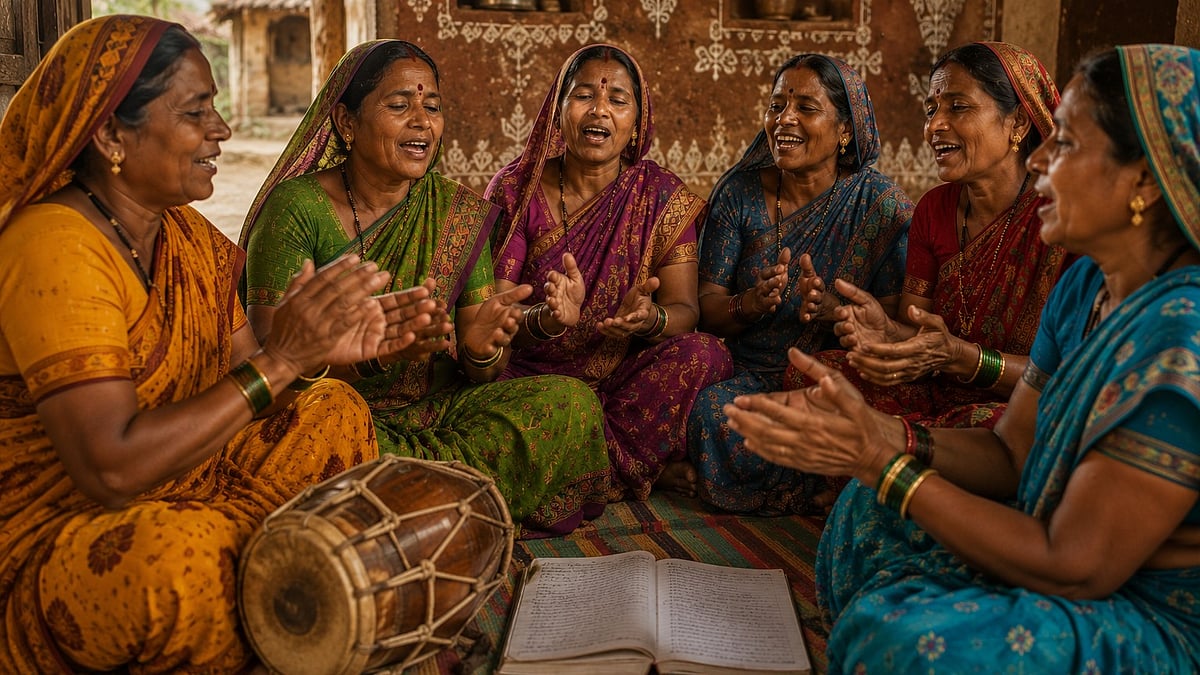
Before the village wakes, women get to work. Their hands have turned rough rotating the upper stone to pulverise grain into meal for the family. As the stone turns, melody begins. These are the ovi—the traditional grindmill songs of Maharashtrian women.
Passed down for centuries from mother to daughter, these verses float through the morning air like a softly breathed secret. To a casual passer-by, they might sound like simple folk tunes. But listen closer, feel the raw human cadence, and you will hear a sacred archive of female endurance. In a world that systematically rendered them invisible, denied them an education, and stripped them of a public voice, rural women turned the jaat into their pulpit, their sanctuary, and their court of law.
Landscape of rural song
To grasp the significance of the ovi, one must view it against Maharashtra’s broader folk music traditions. Rural life has always been saturated with song, but almost every other genre belonged to the public square, the temple courtyard, or the festive stage—spaces traditionally dominated by men or curated for an audience.
There were the high-energy martial ballads of the Powada, where male Shahirs shouted heroic chronicles of Chhatrapati Shivaji Maharaj. There were the allegorical skits of the Bharud, popularised by Sant Eknath, mocking human hypocrisy with biting satire. In temple courtyards, the lyrics of the Abhang echoed as Warkari pilgrims marched toward Pandharpur. During household milestones, the Gondhalis performed dramatic narrative rituals to the thunder of sambhal drums. Out in open fields, men and women sang Bhaleri to synchronise the grueling work of sowing and harvesting. On festive stages, the seductive rhythms of the Lavani captured romance and social commentary to the beat of the dholki.
Yet, all these musical forms were performed outwardly for a gathered crowd.
Where, then, could a woman turn when her heart was heavy with unspoken grief? Where could she sing without an audience, without a costume, and without asking permission from patriarchs? She found her private stage inside the dim kitchen, sitting before the circular stone of the jaat.
Sanctuary at the Stone Mill
Inside domestic walls, a rural woman's voice was strictly policed. She could not talk back to elders, complain about an abusive husband, rail against dowry, or weep openly for a lost child. She found refuge in the motion of the stone mill. The jaat became a confidante that never judged and never betrayed. Its rhythmic whir provided both a tempo for her grief and a cover for her tears. In that extreme physical exertion, emotional catharsis broke free.
Unlike the Powada or Bharud, these songs were survival strategies. Women sang because if they did not turn their agony into poetry, the weight of their lives would crush them into dust. As Hausabai Dighe, a peasant worker and singer, famously shared, "When I return from labouring in the fields and find there’s no flour, I sit down at the grindmill and sing as I work. Our day feels incomplete without it. The songs flow as I remember the words. These songs will stop only when I die."
Instinctive riyaaz and sadhana
For classical musicians who spend decades mastering formal vocal technique, the instinctive precision of these unlettered women is a source of profound wonder.
Distinguished classical and devotional vocalist Rahul Deshpande, whose celebrated concert initiative Abhangawari marks its twelfth year of bringing devotional heritage to audiences across India, observes, "Classical music gives us grammar, discipline and structure, but these women sing from lived experience. Their music is not born out of performance; it is born out of life itself. The rhythm comes from the turning of the grindmill, the breath comes from physical labour, and the emotion comes from everyday existence. You cannot manufacture that authenticity."
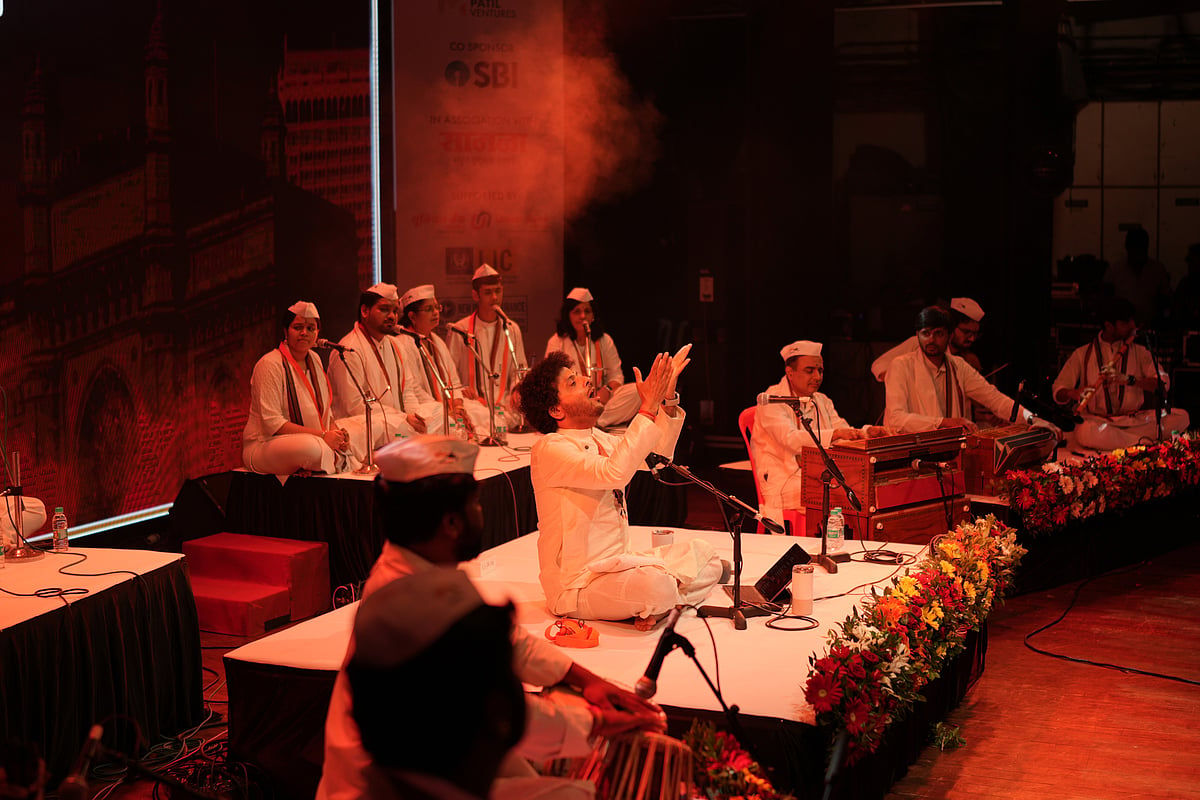
Mahesh Kale performs at his concert Abhangwari |
Renowned maestro Mahesh Kale echoes this sentiment, noting how the sheer repetition of domestic chores mirrors formal musical practice. "When you consider how many hours these women spend at the mill, you realise that whatever material they sing, they end up rehearsing over and over again. In its true spirit, that is precisely what riyaaz is. So, unknowingly and unintentionally, these women are performing riyaaz."
Deshpande adds that physical labour shaped the very mechanics of rural vocal music. "The body itself became an instrument. Every movement created rhythm, every breath created a phrase, and every task became music... Folk music carries the pulse of the earth. It reflects the sound of labour, nature and shared living."
Domestic reality and spiritual legacy
The ovi deal directly with the visceral reality of being female in an unequal world. Women recorded the painful transition from the warmth of maher (the natal home) to the cold environment of the sasural (the in-laws' house). In one moving verse, Gangubai Ambore compares her grief to Sita's banishment:
Rani vanat ranat, kon rodan karite?
Aika bori-babhali, Sitela mauli vette!
"In the forest, in the woods, who is weeping? Listen! Bori-babhali [jujube and acacia trees] are the 'women' who listen to and console Sita."
Yet beneath the sorrow ran an undeniable current of subversion. Women poked fun at arrogant elders, mocked hypocritical priests, and whispered anti-dowry protests (Sodava hunda prapanchat, joda samata bandhan). When Bhimrao Ramji Ambedkar launched his crusade against caste oppression, unlettered women wove his message of dignity straight into their millstone verses ("Gaadi aali Bhimachi tichya bonnet-la jaali...").
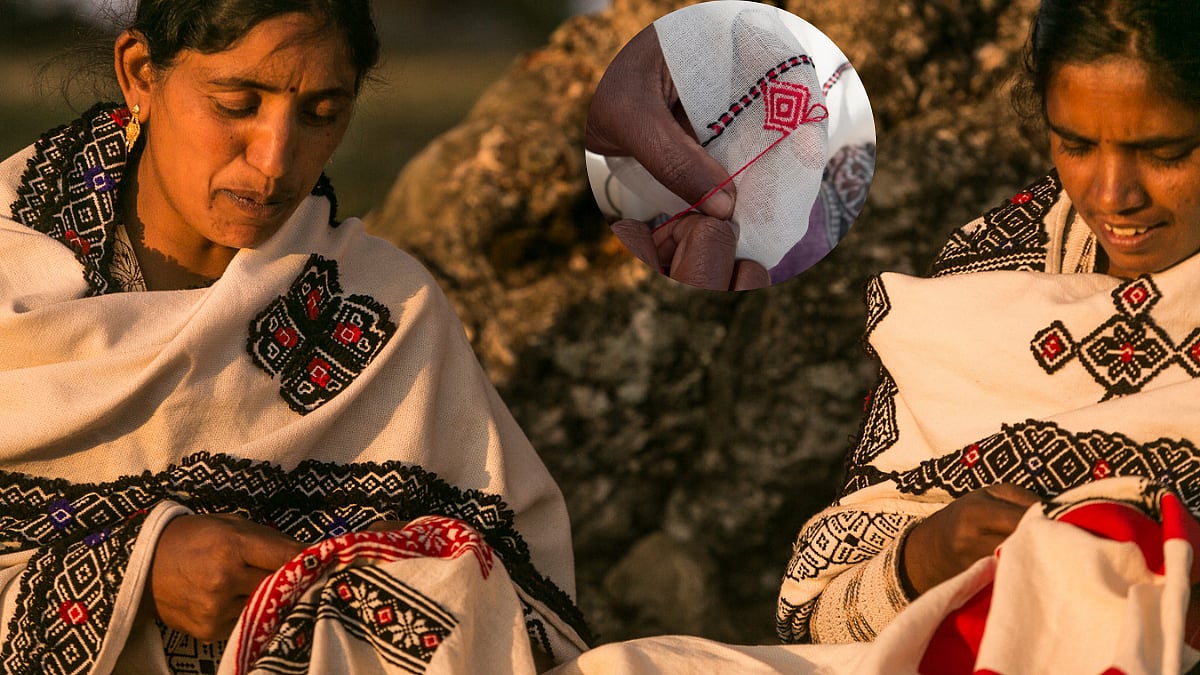
This living tradition traces back to Maharashtra’s historic female saint-poets—Muktabai, Janabai, and Soyarabai—who composed immortal spiritual poetry while performing domestic chores. As Rahul Deshpande points out, "Saints like Janabai, Muktabai and Soyarabai transformed everyday work into devotion. Grinding grain, sweeping a courtyard, drawing water or cooking were never separate from spirituality. Every action became an offering to Vitthal... I feel privileged to be only a medium carrying forward a tradition that countless women and saints nurtured long before any of us came onto the stage."
Mahesh Kale reinforces this debt, "I think we all owe our musical credit—and indeed, everything in life—to mothers... They inspired the landscape of devotional music while going about their daily lives."
Reimagining the echoes
As electric flour mills replaced the manual jaat in the late 20th century, these ancient songs faced extinction. Visionary activist Hema Rairkar, alongside French sociologist Guy Poitevin, set out in the late 1980s across 1,107 villages to document over 110,000 ovi, treating peasant women as original poets and intellectual partners.
Today, bringing these rural roots to urban concert halls requires maintaining strict emotional integrity. "Traditions survive only when they continue to be lived, not when they are preserved behind glass... Modern sound, lighting and concert production are only tools—they should never replace the spirit of the music. If even one young listener leaves a concert wanting to read Sant Janabai, discover an ovi, or sing an abhang at home, we have succeeded," Deshpande emphasises.
While the Powada thunders on stages, the Abhang echoes along pilgrimage routes, and the Bharud entertains village fairs, the ovi remains the gentlest yet most potent reminder of female resilience—proving that true history is also made in the pre-dawn dark by women turning pain into poetry.
Bahinabai Chaudhari (1880–1951) — The Legendary Voice of Khandesh
No celebration of Maharashtra’s oral traditions is complete without Bahinabai Chaudhari, a pioneer who proved that profound literary genius requires neither formal schooling nor a pen.
Born in the cotton-growing region of Jalgaon, Bahinabai was entirely unlettered and faced the crushing weight of early widowhood. Yet, as she worked in the fields and tended to her household chores, verses poured out of her in her native Khandeshi dialect. She spoke her poetry aloud, using the ovi form to process grief, celebrate nature, and decode the human condition.
It was her son, Sopandev Chaudhari, who recognised the extraordinary philosophical brilliance in his mother’s daily recitations. He meticulously transcribed her spoken verses, publishing them after her passing and securing her place as one of the most revered figures in Marathi literature.
Core Themes in Bahinabai’s Verse
Resilience and Independence: Rather than allowing widowhood and societal restrictions to define her, her poetry radiates quietly fierce self-reliance and emotional endurance.
Everyday Philosophy: She transformed routine agricultural labour—sowing seeds, weeding crops, and baking bread—into timeless metaphors for life, fate, and human desire.
Spiritual Connection to Nature: Her relationship with the earth was intimate and maternal, viewing every seed sprouting in the soil as a divine, living presence.

