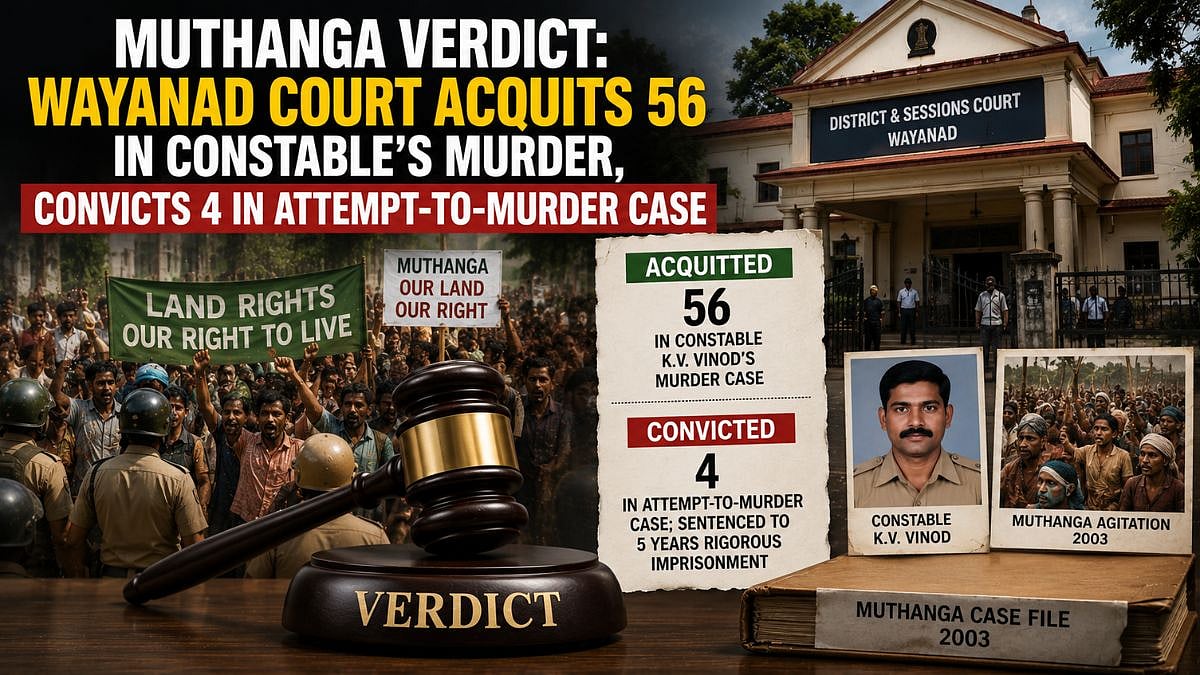
Wayanad, July 31, 2026: More than 23 years after the Muthanga agitation shook Kerala, a court in Wayanad on Friday acquitted 56 surviving accused, including tribal leader M. G. Geethanandan, in the 2003 murder of police constable K. V. Vinod.
However, the court convicted four persons, including Geethanandan, in a related attempt-to-murder case and sentenced them to five years of rigorous imprisonment.
Wayanad District and Sessions Judge Ayyoob Khan E. acquitted all the surviving accused in the murder case of Vinod while holding second accused Asokan guilty.
Asokan, however, died during the pendency of the trial and no sentence was pronounced against him. Around 15 accused died while the case was being heard over the years.
Split Verdict After Two Decades
In the connected case involving the attempted murder of police officer Abdul Salam and forest officer Sasidharan during the same incident, the court found Geethanandan, Binu, Ramesan and Anilkumar guilty.
Although the total sentence under various sections came to 19 years, the court directed that all the sentences would run concurrently, meaning the four will serve five years in prison.
The court also ordered compensation under the victim compensation scheme. It awarded Rs 7 lakh to Vinod's family, Rs 5 lakh to Abdul Salam and Rs 2 lakh to Sasidharan.
Vinod, a native of Kannur, was killed on February 19, 2003, during police action to evict tribal protesters who had occupied land inside the Muthanga Wildlife Sanctuary, demanding land rights.
The case was first investigated by the local police before being handed over to the Crime Branch and later the Central Bureau of Investigation (CBI).
According to the prosecution, Vinod and forest officer Sasidharan were taken hostage inside a makeshift shed during the confrontation at Gowdanvayal in Thakarappadi, where the 47-day land occupation protest led by tribal leaders C. K. Janu and Geethanandan had reached its peak. The prosecution alleged that Vinod was killed while in captivity, PTI reported.
During the trial, the prosecution examined 47 witnesses and produced 13 material objects as evidence.
Families React To Verdict
Defence counsel T. M. Rasheed welcomed the verdict, saying the court had considered the social background of the convicted persons while deciding the sentence. He also said the court made observations recognising the Muthanga agitation as a movement for a legitimate cause.
Rasheed alleged that despite the CBI investigating the case for nearly 16 years, the agency failed to identify those actually responsible for the deaths of Vinod and tribal protester Jogi.
"Two persons were killed inside the same shed within minutes of each other and in the presence of hundreds of police personnel and officials. Yet the real culprits could not be identified," he said, adding that the convicted persons would challenge the judgment before the Kerala High Court.
He also expressed disappointment that while compensation had been awarded to Vinod's family and the injured officials, no compensation had been ordered for Jogi's legal heirs. Rasheed further said the court observed that struggles for legitimate rights could not be viewed on the same footing as extremist activities.
Vinod's brother, retired Assistant Superintendent of Police K. V. Babu, expressed disappointment over the acquittals, saying the family had waited more than 23 years for justice.
"We heard the verdict with a numb heart. After waiting for twenty-three and a half years, this is deeply disappointing. This is not just about our family but also about the police force and society," he told reporters.
Babu alleged there were shortcomings in the investigation and prosecution and said the family would consult legal experts before deciding on further legal action.
He also recalled the difficulties his family faced in securing benefits due to Vinod's parents after his death. According to Babu, the family pension was sanctioned only after the intervention of the Human Rights Commission, while compassionate appointment was denied under the existing rules.
He said justice should also be ensured for Jogi, the tribal protester who was killed during the police action.
"My father waited for years hoping to see justice in the case. Sometimes I feel it was perhaps better that he was not alive to hear this verdict," Babu said.
Background Of The Agitation
The Muthanga agitation was a land rights movement led by the Adivasi Gothra Maha Sabha in 2003, demanding that the then United Democratic Front (UDF) government fulfil its promise of providing land to landless tribal families.
As part of the protest, hundreds of tribal families entered the Muthanga Wildlife Sanctuary and set up makeshift shelters on forest land. The agitation turned violent on February 19, 2003, when police and forest officials launched an operation to evict the protesters, resulting in the deaths of Vinod and tribal protester Jogi.
Also Watch:

The verdict brings legal closure to one of Kerala's longest-running criminal trials. However, the contrasting reactions from the victims' family and the defence underline that, even after more than two decades, the Muthanga agitation remains as much a debate over justice and accountability as it is a reminder of the unresolved questions surrounding land rights and the state's response to tribal protests.
To get details on exclusive and budget-friendly property deals in Mumbai & surrounding regions, do visit: https://budgetproperties.in/

