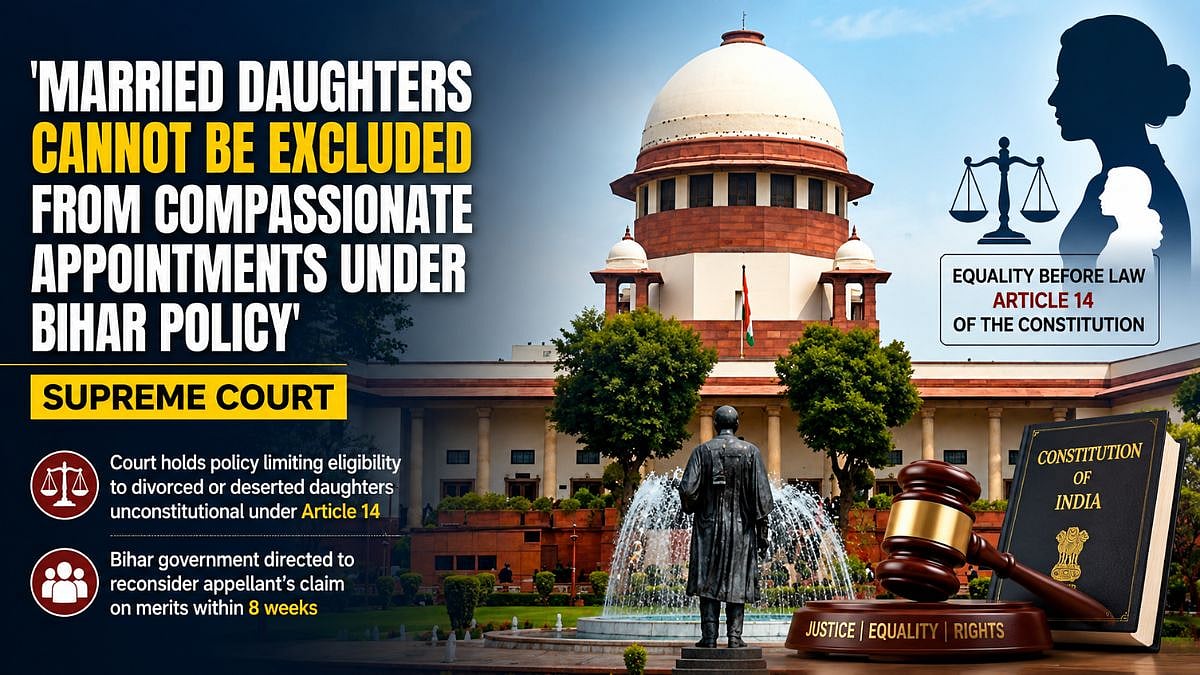
New Delhi, July 31, 2026: The Supreme Court has ruled that a married daughter cannot be denied consideration for compassionate appointment merely because a state government policy allows such appointments only to divorced or deserted daughters, holding that such a classification is unconstitutional and violative of Article 14 of the Constitution.
A Bench of Justices M.M. Sundresh and Prasanna B. Varale allowed an appeal filed by Sayara Khatoon and her daughter against a Patna High Court order, which had upheld the rejection of the daughter's claim for compassionate appointment following the death of her father.
The appellants had questioned the Bihar government's December 10, 2014, policy, under which only a divorced or deserted daughter is eligible for compassionate appointment.
Grounds For Rejection
The state government had also rejected the claim on the ground that the deceased employee's brother had objected to the appointment.
However, the Supreme Court recorded that the brother had earlier furnished a no-objection certificate, observing that "the said ground for rejection no longer survives".
On the policy restricting compassionate appointment to divorced or deserted daughters, the Justice Sundresh-led Bench held that any distinction between sons and daughters in such matters is constitutionally impermissible.
"This Court has repeatedly held that any classification differentiating a daughter from a son is, per se, unconstitutional," the apex court said.
It added that "classification restricting eligibility only to a divorced or deserted daughter cannot be sustained in the eye of law".
Court's Observations
Rejecting the presumption underlying the Bihar government's policy, the Supreme Court observed: "There cannot be a presumption in law that, after marriage, a daughter severs her ties with her parental family and resides with her husband in her matrimonial home."
The order noted that the appellant had specifically stated that although her divorce had not been formally recognised in law, she had been living with her parental family and enjoyed the support of her mother and brother.
"In any event, adopting a hyper-technical approach cannot be a ground to deny consideration of her claim for compassionate appointment," the Bench said.
Also Watch:

Direction To Bihar Government
Setting aside the Patna High Court's order as well as the rejection of the compassionate appointment claim, the apex court directed the Bihar authorities to reconsider the appellant's case on merits.
"The respondent (Bihar government) is directed to consider the case of the appellant for compassionate appointment on merits within a period of eight weeks from the date of receipt of a copy of this order," it ordered.
(Disclaimer: Except for the headline, this article has not been edited by FPJ's editorial team and is auto-generated from an agency feed.)

