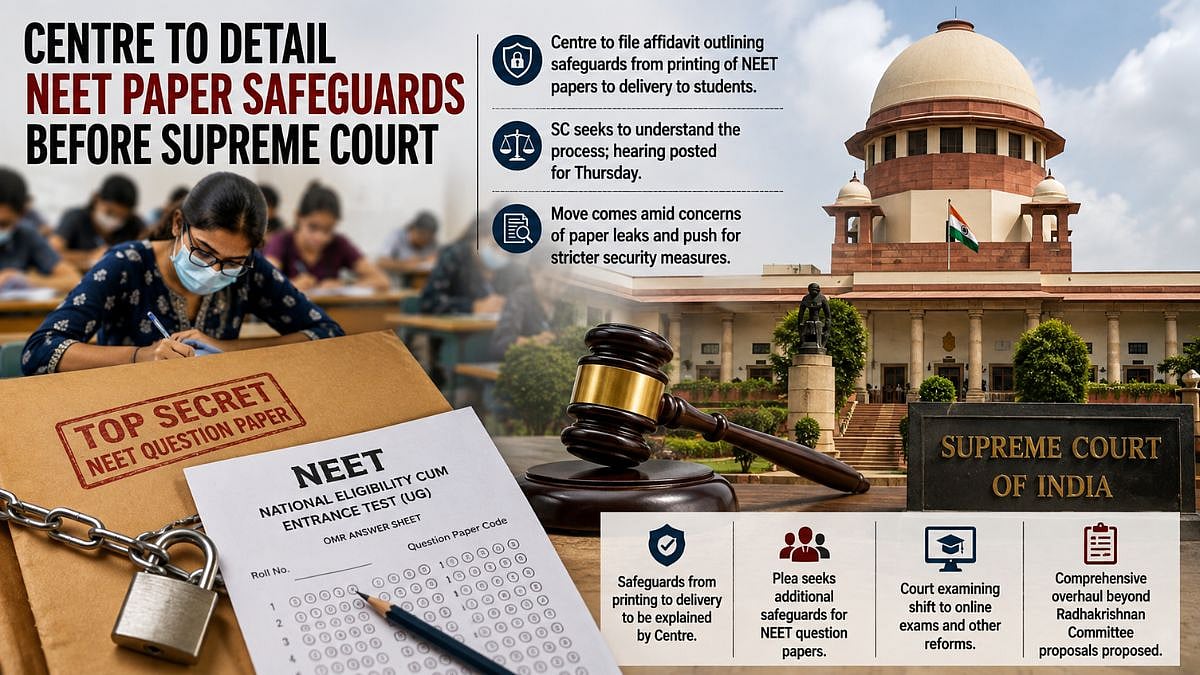
New Delhi, August 3, 2026: The Centre on Monday told the Supreme Court that it would place on record the safeguards followed from the printing of NEET question papers until they reach students.
Solicitor General Tushar Mehta told a bench of Justices P.S. Narasimha and Alok Aradhe that the government wanted to explain the methodology through an affidavit, which would be filed during the day.
Mehta sought a hearing on Thursday or Friday. The bench said it would also like to understand the process and posted for Thursday a batch of pleas seeking additional safeguards for NEET question papers. The development puts the question paper handling process under closer scrutiny as the court examines measures intended to prevent leaks.
Paper Leaks Under Lens
The court has been examining the issue against the backdrop of repeated concerns over question paper leaks. On July 27, while hearing a plea by Rashtriya Janata Dal (RJD) leaders, it said it would see what the Nandan Nilekani-led high-powered task force formed by the government recommends on conducting NEET online.
The court had said some "out-of-the-box suggestions" were needed, particularly for a transition from the physical mode to online examinations. Mehta had told the bench that the Union government had taken a serious view of repeated question paper leaks and constituted a high-level committee, PTI reported.
Mehta said Prime Minister Narendra Modi had announced the committee, headed by technology expert Nandan Nilekani. Its other members are former ISRO chairman S. Somanath, former Intelligence Bureau director Tapan Deka, IIT Madras Director V. Kamakoti, former Education Secretary Anita Karwal and logistics expert Amrit Lal Meena.
The push towards an online examination model signals an attempt to address vulnerabilities in the existing system, but the court's proceedings also show that safeguards, transparency and accountability remain central to any overhaul.
Court Seeks Accountability
On June 24, the Supreme Court told the Centre it would closely monitor measures to curb NEET paper leaks, observing that ad hocism had caused trouble for years. It was hearing petitions, including one filed by the Federation of All India Medical Association (FAIMA).
The court asked the government to indicate steps taken towards transparency, implementation of the Radhakrishnan Committee's recommendations and adoption of the IIT model.
The seven-member Radhakrishnan Committee was constituted by the Ministry of Education following the NEET-UG paper leak. It was tasked with recommending reforms in the examination process, improvements in data security protocols and changes to the structure and functioning of the National Testing Agency (NTA).
One of the petitions has sought the replacement or restructuring of the NTA with a robust and autonomous body to conduct the medical entrance examination.
Overhaul Beyond Committee Proposals
Mehta had told the court that the government would file a detailed report on a comprehensive overhaul of the examination process that could go beyond the Radhakrishnan Committee's recommendations.
"Students' futures can't be jeopardised. We are going beyond the Radhakrishnan Committee. I assure you that the government is walking 10 extra miles. I can assure you everything is being supervised at the highest level," Mehta had submitted.
Advocate Tanvi Dubey, appearing for FAIMA, had sought a detailed blueprint of the standard operating procedure for the computer-based test model that the NTA would implement for NEET-UG from next year.
The government's promise of a wider overhaul raises the stakes. With students' futures tied to the credibility of the examination, changes will ultimately be judged by whether they can deliver a secure and transparent system rather than remain procedural assurances.
NEET Controversy Continues
On May 29, the Supreme Court said the real problem surrounding the National Eligibility-cum-Entrance Test (Undergraduate), or NEET-UG, would not end until "actual accountability arises".
Mehta had told the court that the government was seriously concerned about the youth and that Prime Minister Modi was personally supervising the situation so that "there is no lacunae".
The court had also noted an affidavit filed by Dr K. Radhakrishnan, former ISRO chairman and chairman of the high-powered steering committee on NTA reforms, detailing implementation of the committee's recommendations and the future course of action.
Also Watch:
The NTA cancelled the NEET-UG examination held on May 3 following allegations of a paper leak. A retest was conducted on June 21. The Central Bureau of Investigation (CBI) is investigating the paper leak allegations.
The controversy follows allegations that NEET-UG question papers were leaked in 2024. The Supreme Court had then refused to cancel the examination but issued directions aimed at tackling paper leaks and laid down a criterion for cancelling public examinations.
To get details on exclusive and budget-friendly property deals in Mumbai & surrounding regions, do visit: https://budgetproperties.in/

