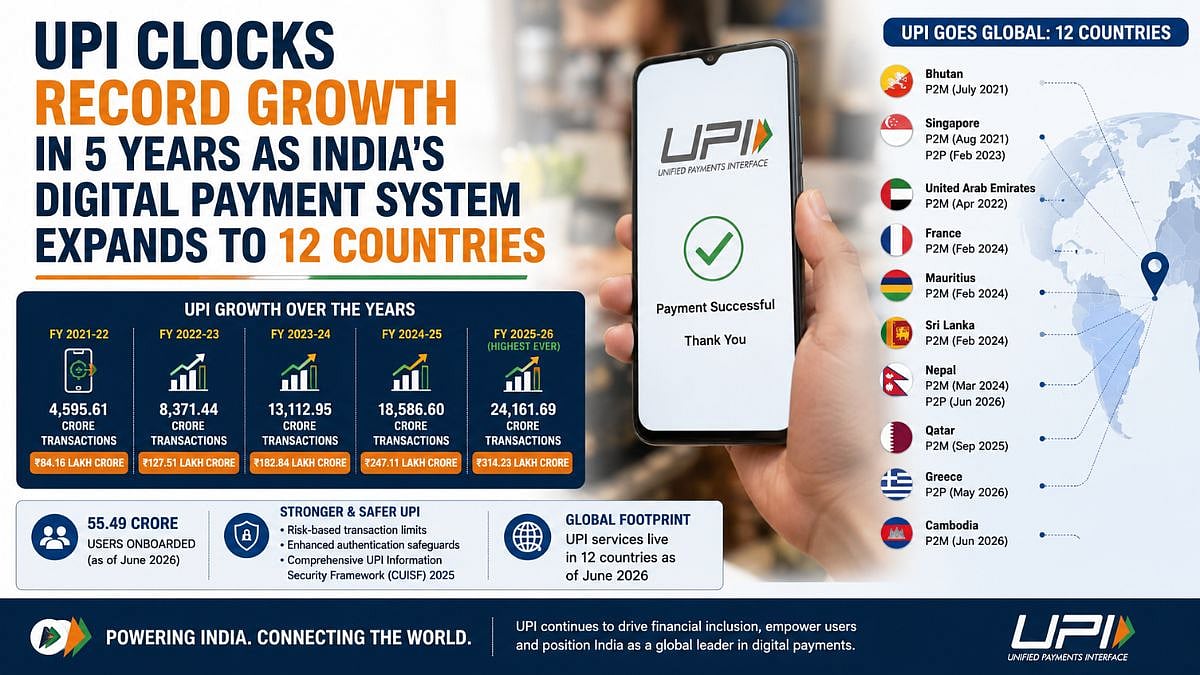
New Delhi, July 20, 2026: India's Unified Payments Interface (UPI) has witnessed remarkable growth over the past five financial years, cementing its position as the country's primary digital payment platform.
Alongside record transaction volumes and values, the made-in-India payment system has also expanded its footprint internationally, with 12 countries now adopting UPI-enabled payment services through partnerships with local financial institutions.
The figures were shared by Union Minister of State for Finance Pankaj Chaudhary in a written reply in the Lok Sabha on July 22, 2026, during the ongoing Monsoon Session of Parliament.
Responding to questions raised by Lok Sabha MP Dr Manna Lal Rawat, the minister also outlined the government's efforts to strengthen the security and transparency of UPI transactions.
UPI Sees Record Growth
Launched on April 11, 2016, by the National Payments Corporation of India (NPCI) under the regulatory supervision of the Reserve Bank of India (RBI), UPI has emerged as the backbone of India's digital payments ecosystem. The platform is authorised under the Payment and Settlement Systems Act, 2007.
According to the minister, 55.49 crore users had been onboarded onto the UPI platform as of June 2026.
The growth in transactions has been equally significant. In FY 2021–22, UPI processed 4,595.61 crore transactions worth Rs 84.16 lakh crore. This increased to 8,371.44 crore transactions in FY 2022–23, followed by 13,112.95 crore in FY 2023–24 and 18,586.60 crore in FY 2024–25.
FY 2025–26 marked UPI's highest-ever performance, with the platform processing 24,161.69 crore transactions valued at Rs 314.23 lakh crore. The steady rise in both transaction volume and value underlines the growing reliance of consumers and businesses on digital payments, making UPI one of India's most impactful financial technology initiatives.
Along with sharing user and transaction data, Chaudhary said the government, RBI and NPCI have introduced several measures over time to improve the safety and transparency of UPI-based transactions, IE reported.
These include risk-based transaction limits to curb fraudulent transactions, safeguards against unauthorised mobile number changes and misuse of SMS-based authentication, and enhanced security requirements for UPI applications.
NPCI has also issued the Comprehensive UPI Information Security Framework (CUISF) 2025 and the Mobile Application Security Framework to strengthen the resilience of the UPI ecosystem.
Global Expansion Continues
The government also highlighted UPI's expanding international presence through NPCI International Payments Ltd. (NIPL), a wholly owned subsidiary of NPCI established in April 2020. NIPL works with foreign institutions to take NPCI's payment platforms, including UPI and the RuPay card network, to overseas markets.
According to the minister, the initiative enables Indian tourists and the Indian diaspora to make seamless cross-border payments while also helping partner countries develop UPI-like real-time payment systems or RuPay-like domestic card schemes.
As of June 2026, UPI services have gone live across 12 international partnerships spanning person-to-merchant (P2M) and person-to-person (P2P) payments.
Bhutan became the first country to adopt UPI for P2M payments in July 2021 through RMA Bhutan. Singapore followed with P2M services in August 2021 through NETS Singapore Pte. Ltd., HitPay Payment Solutions Pte. Ltd. and LiquidPay Group Pte. Ltd., before launching P2P payments with BCS PayNow in February 2023.
The United Arab Emirates introduced P2M payments in April 2022 through Mashreq Bank PSC (NeoPay), Network International and Magnati-Sole Proprietorship LLC. France, Mauritius and Sri Lanka launched P2M services in February 2024 through LYRA Network, the Bank of Mauritius and LankaPay Pvt. Ltd., respectively.
Nepal rolled out P2M payments through FonePay Payment Services Ltd. in March 2024 and later introduced P2P payments through Nepal Clearing House Limited (NCHL) in June 2026.
Qatar joined the network in September 2025 through Qatar National Bank, while Greece launched P2P services through Eurobank S.A. in May 2026. Cambodia became the latest addition in June 2026 with P2M payments through ACLEDA Bank PLC.
Also Watch:

The continued expansion of UPI, both within India and overseas, signals the growing acceptance of India's digital payment infrastructure. With record transaction numbers, stronger security measures and increasing global partnerships, the platform continues to strengthen its role in shaping the future of digital payments.
To get details on exclusive and budget-friendly property deals in Mumbai & surrounding regions, do visit: https://budgetproperties.in/

