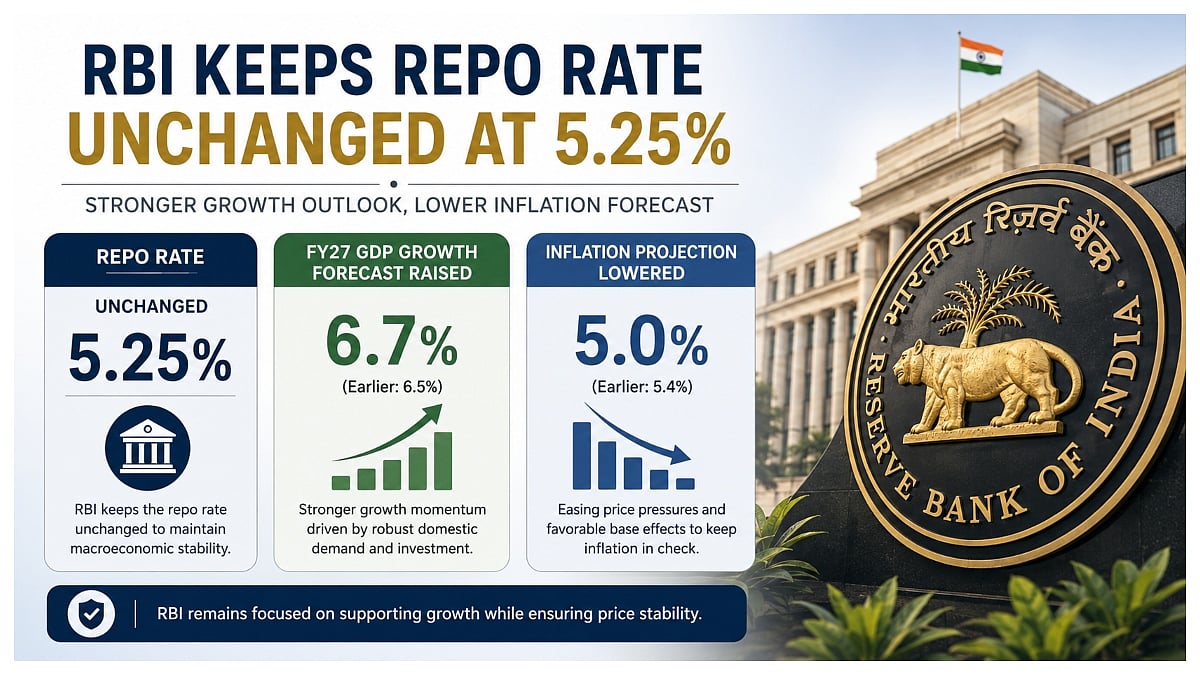
Mumbai: The Reserve Bank of India (RBI) kept the repo rate unchanged at 5.25 percent and retained its neutral policy stance. It also raised India’s FY27 GDP growth forecast to 6.7 percent and lowered its inflation estimate to 5.0 percent from 5.1 percent.
Business Confidence
The IMC Chamber of Commerce and Industry welcomes the RBI decision to keep the policy repo rate and retain the neutral monetary policy stance.
I as president of IMC see this as an indication of resilience in India’s economy. I say this because, Stability in Policy is one of the most important factor for Industry & Commerce including Banking Sector because better business decisions can be taken due to predictability of policy direction.
The upward revision in the GDP growth projection to 6.7% is an encouraging affirmation of the resilience of the Indian economy, driven by sustained domestic demand, investment activity and the strength of the services sector. Equally reassuring is the downward revision in the inflation forecast to 5.0% from the earlier 5.1%, together with an even more benign outlook for core inflation, indicating that underlying demand-side price pressures stay well contained. The expectation of improved systemic liquidity should further facilitate efficient transmission of credit to productive sectors of the economy.
The RBI’s assessment of a resilient economy, a manageable current account deficit and a stable financial system provide confidence that India’s macroeconomic fundamentals are robust despite an increasingly uncertain global environment.
The continuation of the neutral policy stance reflects confidence in the economy and commitment to remain vigilant. The central bank has rightly retained the flexibility to respond to evolving growth-inflation dynamics while carefully monitoring global risks, including continuing geopolitical tensions, volatility in energy markets and uncertainty surrounding international trade, particularly the uncertain US tariff regime.
The IMC believes that this calibrated policy approach strikes the right balance between sustaining economic growth and safeguarding price stability. Policy continuity, coupled with improving growth prospects and moderating inflation expectations, will strengthen business confidence, support investment decisions and reinforce India’s position as one of the world’s most resilient major economies.
Rates May Stay
Shubhada Patil, Founder and Managing Director of Quantace Research, said markets should view 5.25 percent as the main scenario, but not as a guaranteed rate.
She expects an extended pause, although the RBI could raise the repo rate to 5.50 percent if crude oil prices rise, the rupee weakens, or core and services inflation becomes more widespread.
According to Patil, a longer rate pause may benefit deposit-rich banks, capital goods and infrastructure companies. A defensive rate increase could hurt NBFCs, real estate, automobiles and consumption linked to loan instalments.
Cautious Outlook
Emkay Global Financial Services Chief Economist Madhavi Arora described the policy as cautious but constructive. She said the RBI is balancing risks from the Middle East conflict, tighter global financial conditions and El Niño against resilient domestic growth and foreign currency inflows.
Arora noted that near-term price pressure may remain supply-driven unless it spreads widely.
Housing Support
Knight Frank also welcomed the rate pause. It said stable borrowing costs should improve confidence among homebuyers, businesses and investors. Policy continuity is expected to support finance, housing demand and investment across residential and commercial real estate.

