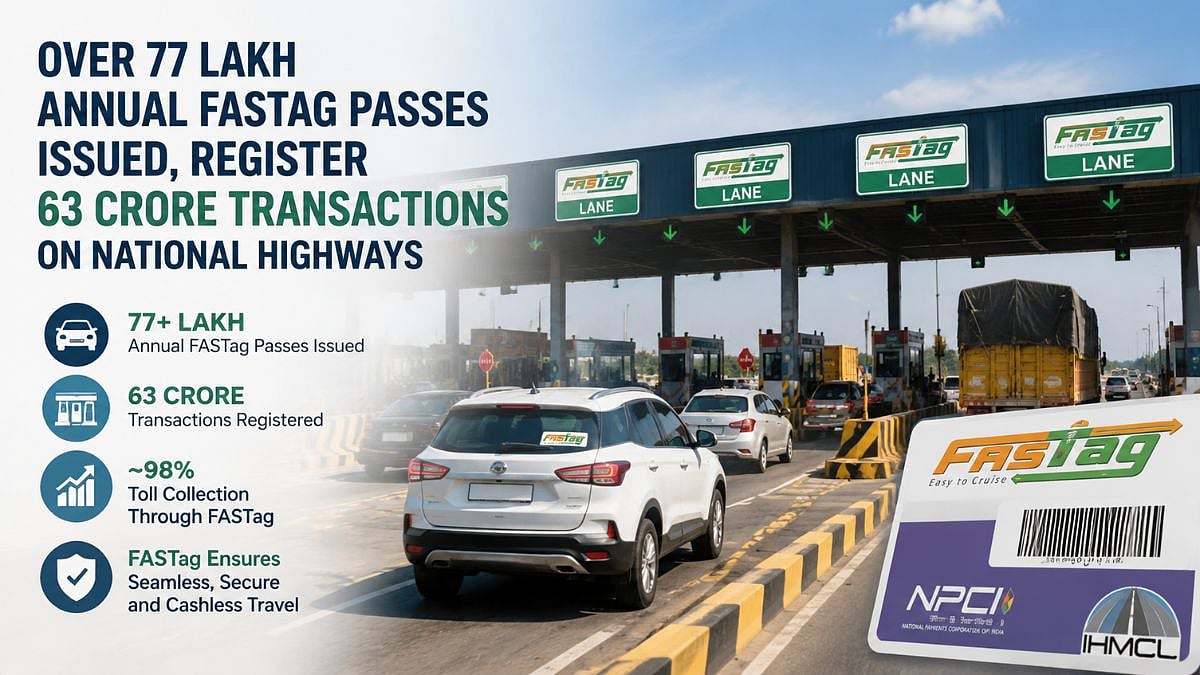
New Delhi, July 22: More than 77 lakh annual FASTag passes have been issued till June, registering 63 crore transactions on National Highway fee plazas, Parliament was informed on Wednesday.
Presently, around 33 per cent of total Electronic Toll Collection (ETC) transactions made by cars, jeeps and vans are annual pass transactions.
The scheme has improved operational efficiency and enhanced the convenience of road users, Union Minister of Road Transport and Highways Nitin Gadkari said in a written reply in the Rajya Sabha.
FASTag Boosts Toll Collection
The National Highways Authority of India (NHAI) has established multiple grievance redressal mechanisms for addressing user fee-related issues on National Highways.
Further, to ensure operational integrity and transparency in user fee collection on National Highways, the government has implemented the FASTag-based electronic toll collection system.
Presently, more than 98 per cent of user fee collection takes place through FASTag under the National Electronic Toll Collection (NETC) programme.
All FASTag transactions are processed in a secure ecosystem involving Toll Management System software, the acquirer bank at the fee plaza, the National Payments Corporation of India (NPCI) as the Central Clearing House (CCH), and the FASTag issuer bank.
Government Highlights Transparent Process
The transaction involves a transparent process wherein the deducted user fee (toll) is informed to highway users and recorded in a central repository.
The Electronic Toll Collection (ETC) system is designed in such a way that no FASTag transaction can take place without the participation of all three stakeholders, namely the acquirer bank at the user fee plaza, NPCI and the issuer bank, the government said.
Also Watch:
Barrier Less Tolling Planned
In an effort to enhance toll operations and enable seamless movement of vehicles, the government has decided to implement MLFF through Automatic Number Plate Recognition (ANPR) with AI analytics and RFID-based Electronic Toll Collection (FASTag), which facilitates barrier-less tolling, where the user fee will be charged from vehicle users without having to stop, slow down or stay in a given lane.

