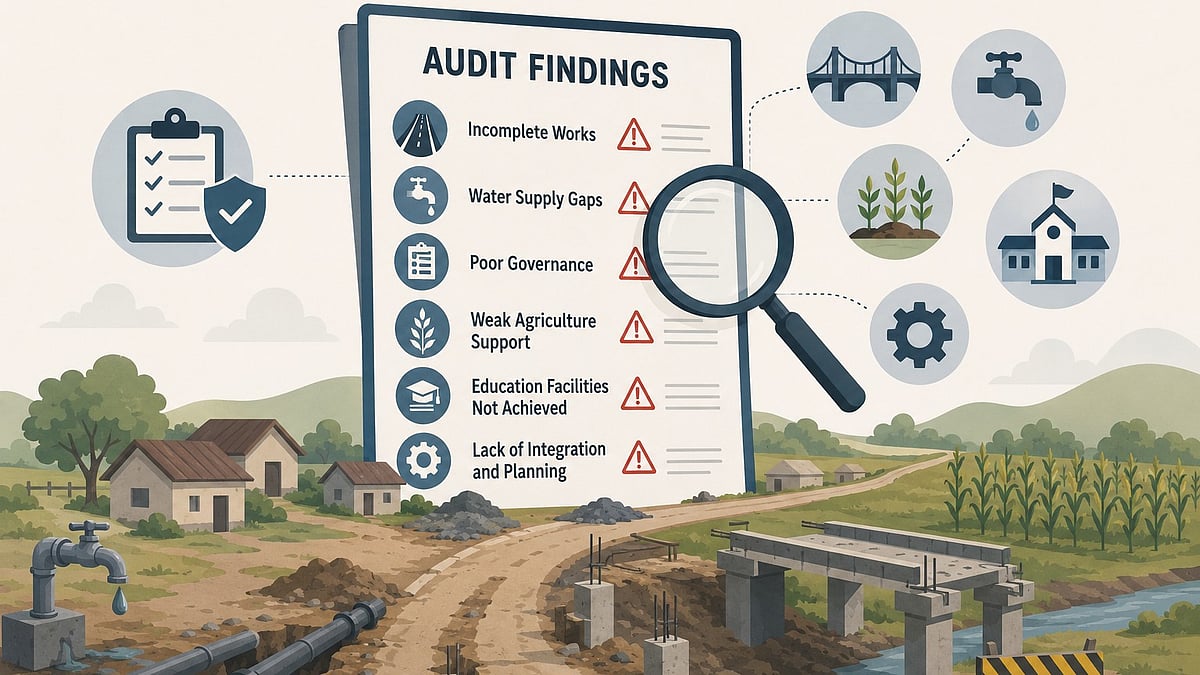
Bhopal (Madhya Pradesh): The audit of the Shyama Prasad Mukerjee Rurban Mission found significant deficiencies in governance, compliance and internal controls, indicating underlying inefficiencies in the mission's implementation across the state.
The Comptroller and Auditor General (CAG) found that although the mission was discontinued on Mar 31, 2022, with instructions from the Government of India (GOI) to complete all sanctioned or committed works, 48% of these works remained incomplete or uninitiated even two years after its discontinuation.
The government executed various infrastructure projects under the mission without spatial mapping of land use and service linkages, undermining the objective of achieving planned and sustainable development of Rurban clusters.
It did not ensure integrated development of the agriculture and allied sectors under the mission, limiting opportunities for income generation and sustainable economic growth within the clusters.
Similarly, the objectives of providing piped water supply to targeted households and establishing smart classrooms to improve education and the mental development of targeted children were not achieved as intended, the audit report stated.
It was also observed that even though provisions were made for developing local infrastructure and skills, execution remained inadequate, resulting in gaps between the intended objectives and actual outcomes.
As the concerned gram panchayats did not enter into MoUs, the revenue-generating assets were not handed over to Self-Help Groups (SHGs), Cluster Level Federations or Village Organisations, leading to the non-commencement of their operation and maintenance activities.
The audit further found that of the total expenditure incurred by the state, 86.86% was met through convergence and only 13.14% through the Critical Gap Fund (CGF), reflecting greater dependence on convergence resources and limited utilisation of CGF funds.
Mission overview
The Government of India (GOI) launched the National Rurban Mission in February 2016 with the objective of providing rural areas with economic development and enhanced enforcement of land reforms. Madhya Pradesh selected 19 growth clusters comprising 167 gram panchayats for project implementation over a five-year period.