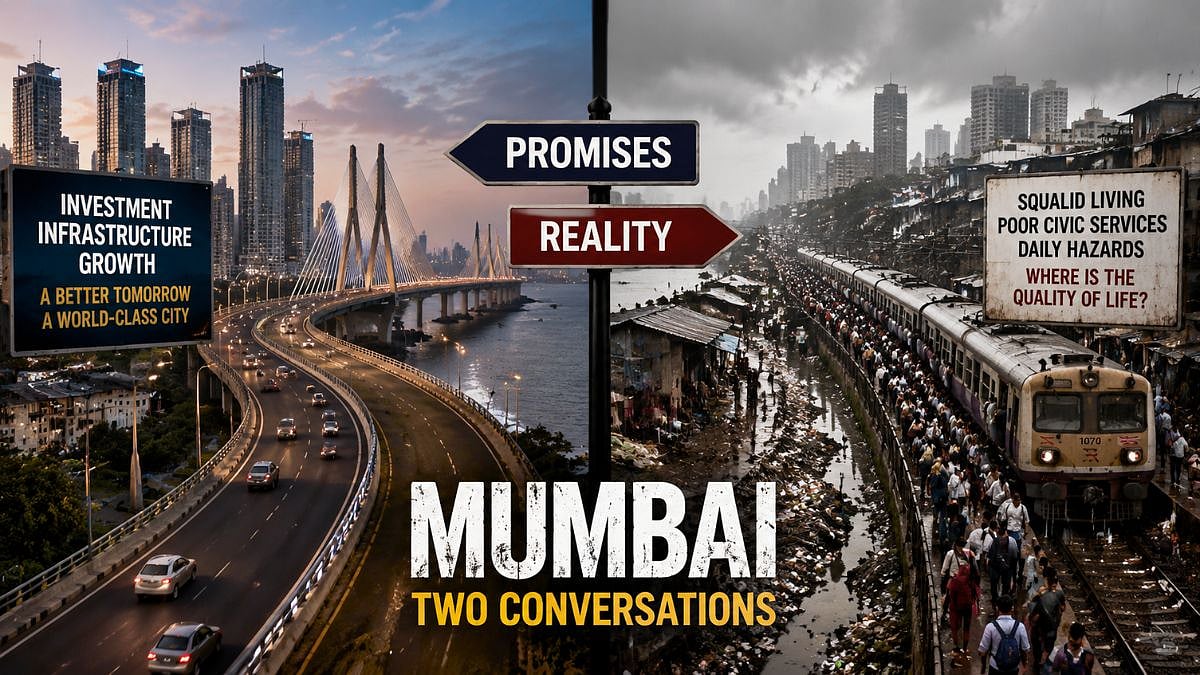
There are two conversations happening in Mumbai, about Mumbai, at any time. They are equally familiar to anyone who lives here; the words and phrases are well worn, and the content is known, but the two hardly have any points of convergence. It’s almost as if they are about two different, diverse cities. In between them, in that wide chasm, millions of people struggle to live and work every day, unsure if they will see the end of the day alive or as a corpse in some wretched corner, a manhole dragging it to the sea, or on a railway track with the contents of a carefully packed lunch box strewn all around.
Two Different Narratives
The first conversation is about the next big investment being made in Mumbai, the next large infrastructure project that’s almost always a road meant for private vehicles, or the next huge proposal that the state government and the Brihanmumbai Municipal Corporation (BMC) are considering. This conversation is usually a promise of a “better tomorrow” and hands out blithe assurances of a “world-class city” that excites so many aspirations in so many millions of people. Mumbaikars live on hope and a slender thread of luck, after all.
The second conversation is Dickensian in nature or, closer home, Dhasalian (after Namdeo Dhasal), about squalid living conditions, non-existent or pathetic civic services across most of the city, or the quality of life being so bleak that only the truly romantic can look past the overflowing garbage and stampede-like situations on every railway platform and bus stop to declare their love for the city. In fact, this conversation rarely features the words “quality of life” because it’s well known that there’s no real quality to speak of; it exists only in the rarefied space in which Mumbai’s 96 billionaires or 1.42 lakh millionaires, of its nearly 18 crore population, live.
Infrastructure Versus Quality Of Life
The first conversation is focused on investment. None less than Maharashtra Chief Minister Devendra Fadnavis stated in the Assembly on July 8 that his government had submitted a Rs 13,000-crore flood control plan for Mumbai to the Centre for approval as part of a broader infrastructure push, that the proposed expansion of the coastal road network would cut travel time from south Mumbai to the proposed Virar offshore airport to barely 50 minutes, that 27 of Mumbai’s open grounds would have underground parking facilities, and that, across the Mumbai Metropolitan Region (MMR), a staggering Rs 12.26 lakh crore worth of infrastructure projects are either under implementation or in the pipeline.
“The multi-decade economic strategy aims to raise MMR’s GDP from the current $84 billion to $825 billion by 2047... Mumbai and the MMR have emerged as Maharashtra’s growth engine, with Mumbai becoming the country’s fintech and startup capital,” Fadnavis stated. He did not say—and no one asked him—how all of this translates into a vastly superior quality of life for the working millions in the city. It is as if the mega investments automatically mean a better life for the majority. Nothing could be farther from the truth.
The Other Mumbai Reality
The second conversation is, therefore, important but rarely heard. It is brought out of the closet a few times a year, when incessant rains flood the city and make daily life hazardous—not difficult but hazardous—or when the air turns toxic. This year, 11 or 12 people lost their lives in the heavy rain, including 11-year-old Vihaan Srivastava, who died when a massive tree fell on his school bus, and three other children—14-year-old Muskan, seven-year-olds Aliya and Munaf—when their house collapsed. Nearly 2,400 people lose their lives or limbs on Mumbai’s railway tracks every year, now rarely discussed amidst the focus on mega-crore freeways.
The BMC found that an unprecedented 1,850 trees had fallen or were uprooted during the downpour but did not accept that it had to do with its blanket concretisation, which weakened their roots. The enquiry committee into the schoolboy’s death, by the BMC itself—in a bizarre instance of one enquiring into one’s misdemeanour—blamed the contractor involved and fined him Rs 7 lakh while absolving its own officials. What else could be expected? That south Mumbai to Virar airport in 50 minutes Fadnavis spoke of will come at the cost of nearly 46,000 mangroves, just as every major infrastructure project has come at the cost of forests and trees, resulting in more floods; it is not spoken of.
Global Rankings Tell Story
But the second conversation does not disappear. On the day Fadnavis promised a better Mumbai in the Assembly, the Economist Intelligence Unit’s Global Liveability Index 2026 placed Mumbai at 121 among 173 cities of the world tracked on 30 indicators in five categories: stability, healthcare, culture and environment, education, and infrastructure. Delhi ranked 120. This underscored, once again, that all the major money poured into a handful of projects does not translate into a good, or even an acceptable, quality of life for millions.
The ranking was not very different from the global cities index that Oxford Economics released two years ago. Among nearly 1,000 cities across the world ranked along five parameters—economy, human capital, quality of life, environmental quality, and governance—Mumbai came in at 427th, with an abysmal and shameful 915 on quality of life. Delhi was at 350, and Bengaluru at 411. Dr Amita Bhide of the Tata Institute of Social Sciences has commented, “…the constant rise in real estate economy is a prop-up by the state, which also has a stake in the same. Moreover, such a growth then blinds the state to pay attention to the vulnerabilities of the city and its people.”
Not only in academia but also in drawing rooms, one-room tenements, overcrowded railway compartments, uncovered bus stops, overflowing bridges, broken pavements, filthy markets, WhatsApp groups, and even in the corridors outside the offices of Fadnavis and Municipal Commissioner Ashwini Bhide, the second kind of conversations happen all the time. Those focused on the first simply never hear these.
Smruti Koppikar, an award-winning senior journalist and urban chronicler, writes extensively on cities, development, gender, and the media. She is the Founder Editor of the award-winning online journal Question of Cities and can be reached at smruti@questionofcities.org.

