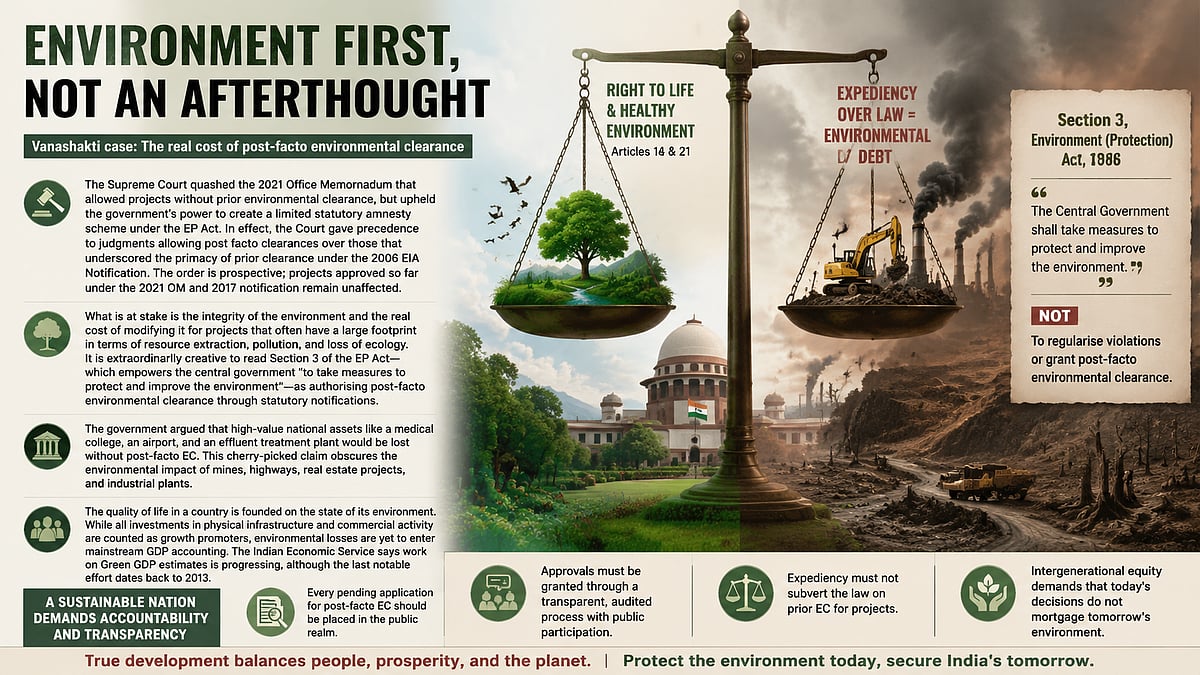
A liberal interpretation of the Environment (Protection) Act in favour of the government's authority to allow some projects to be set up without prior environmental clearance is evident in the Supreme Court’s latest order in the Vanashakti case. Although the three-judge Bench led by Chief Justice of India Surya Kant quashed the Office Memorandum issued by the union government in 2021 that made it possible to permit projects without prior clearance, it upholds the executive’s power to introduce a limited statutory amnesty scheme for such projects under the EP Act. In effect, the SC viewed one set of precedent judgements allowing post facto clearances as having greater salience over others that took a strict view of requirements and underscored the primacy of prior clearance under environment impact assessment regulations dating back to 2006. As a protective measure, the court made its order prospective, and projects approved so far under the 2021 office memo and an earlier 2017 notification remain unaffected. What is at stake here is the integrity of the environment and the real cost of modifying it for projects that often have a large footprint in terms of resource extraction, pollution, and loss of ecology. It is extraordinarily creative to interpret Section 3 of the EP Act as endowing the government with powers to give post facto environmental clearance through statutory notifications when this section only gives the central government power “to take measures to protect and improve the environment”. The government’s arguments against the strict EC regime laid down by the SC in the Vanashakti case last year prompted the court to recall its own order a few months later. It was argued that high-value national assets, such as a medical college, an airport, and an effluent treatment plant, would be lost without post-facto EC. This cherry-picked official claim obscured the environmental impact of mines, highways, real estate projects, and industrial plants.
The quality of life in a country is founded on the state of its environment. While all investments in physical infrastructure and commercial activity are counted as growth promoters, environmental losses are yet to enter mainstream GDP accounting. The Indian Economic Service says work on Green GDP estimates is progressing, although the last notable effort dates back to a distant 2013. As a country with the highest population and limited exploitable land resources, India must tread with great caution on altering its environment. National policy must make a true estimate of costs and benefits central to decision-making consistent with Articles 14 and 21 of the Constitution on the rights to equality and life and the principle of intergenerational equity. Such concerns form the bedrock of the EP Act and EIA notification of 2006. Every pending application for post-facto EC should be placed in the public realm and approvals given through a transparent, audited process. Expediency must not subvert the law on prior EC for projects.

