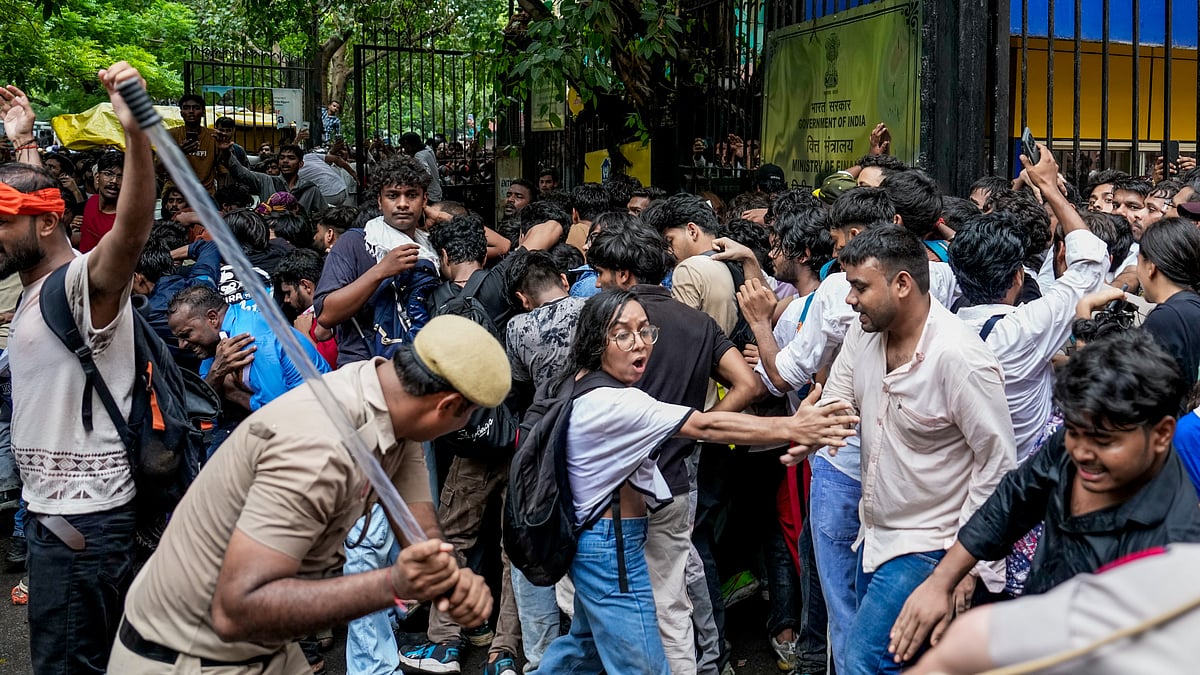
The ugly scenes witnessed when students marching from Jantar Mantar towards Parliament were stopped by the police should disturb every citizen who values democracy. These were not rioters attempting to overthrow the state; they were students protesting against the NEET examination scandal and demanding the resignation of education minister Dharmendra Pradhan. They had assembled peacefully at Jantar Mantar, the designated venue for public protests. Yet, without any visible provocation, the security forces responded with lathi charges, tear gas, pellet guns, and mass detentions.
Students were dragged across the road. Women protesters were handled with shocking insensitivity. Some of the batons used had nails embedded in them. One widely circulated video appears to show a policeman hitting a young woman from behind with his baton. Even more disturbing are reports that the police themselves had stockpiled stones and used them to pelt the students, an act wholly incompatible with the conduct expected of a disciplined force. All this amounts to a deliberate attempt to manufacture violence rather than contain it.
Equally troubling are reports that many policemen had removed their name badges before the operation, making identification virtually impossible. This was not merely excessive force; it was a calculated effort to evade accountability. Equally alarming were videos showing masked men carrying lathis and moving alongside the police while assaulting students. They were not in uniform, nor did they resemble ordinary bystanders.
Their conduct suggested an organised role. Similar allegations surfaced during the violence at Jawaharlal Nehru University, where unidentified hoodlums appeared to operate with remarkable freedom. If private individuals participated in crowd control, the government owes the nation an immediate explanation. The police authority cannot be outsourced to anonymous vigilantes.
These incidents expose a deeper malaise in Indian policing. For centuries, the police have regarded themselves less as servants of the people than as protectors of those who rule. Kings, emperors, colonial administrators, and elected governments have changed, but the institutional instinct has not. The police have traditionally seen their foremost duty as defending the establishment. The events in Delhi painfully reinforce that observation. India still relies in essence on the Police Act of 1861, enacted after the first war of independence. Britain has long replaced it with modern policing, founded on public consent and professional accountability.
India, ironically, continues to preserve the architecture of imperial control. It is deeply ironic that a government which frequently speaks of freeing India from colonial and Mughal legacies should resort to colonial methods when confronted by peaceful citizens. Police exist to uphold the Constitution, not to shield governments from criticism. This week’s events have pushed public confidence in the police to one of its lowest points. Unless there is a judicial inquiry and genuine police reform, that trust will remain badly broken.

