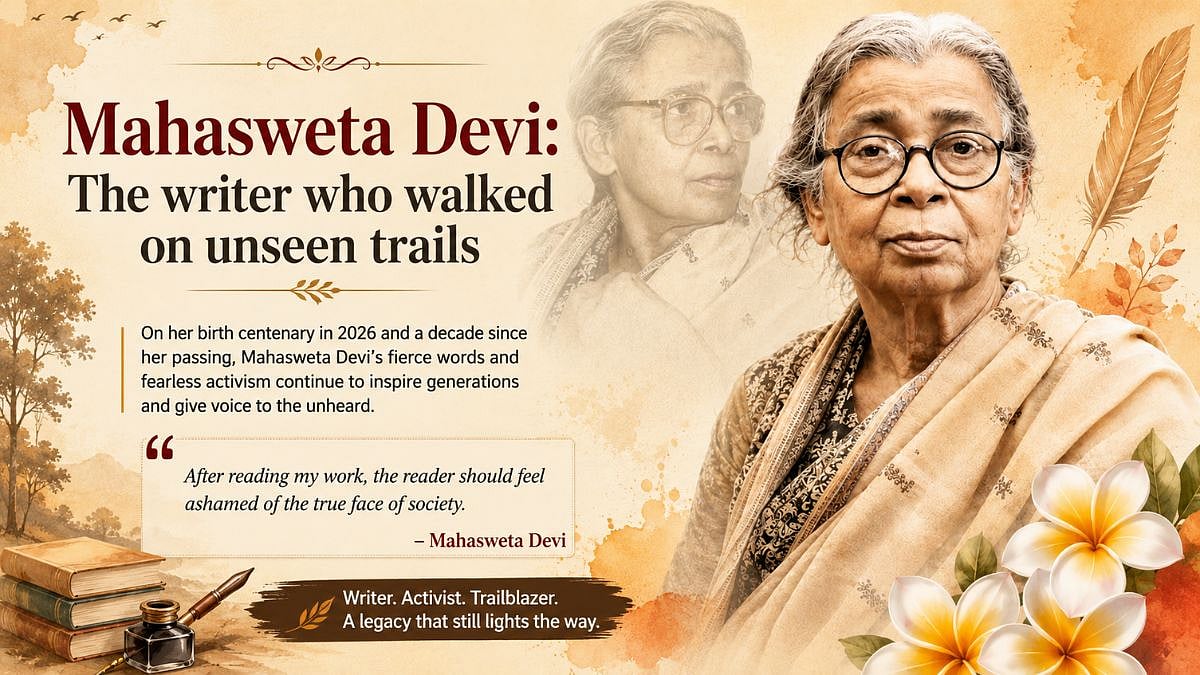
July 28 this year marked ten years without Mahasweta Devi. 2026 also happens to be her birth centenary, and admirers of her writing and activism have been revisiting her unforgettable stories because of the ferocity and compassion of her words.
For her, literature was not separated from the lives of those she cared about and campaigned for—the underprivileged and the oppressed. Today, when there is such political turmoil and apathy towards the rights of marginalised people, Mahasweta Devi would not have just recorded it all in her stories; she would have been on the frontline of the protests.
Every reader would remember the story that led them to her—the most powerful, and probably the most anthologised, must be Dopdi (Draupadi). The protagonist is a Santhal tribal woman and a revolutionary who is hunted by the state forces along with her husband.
She is captured and gang-raped by the police to extract information. Unlike the character from the Mahabharat, after whom she was named, the poor tribal woman is not saved by divine intervention.
The next morning, instead of cowering in shame, as the perpetrators expected, she refuses to put her clothes back on and cover her brutalised body. She walks out naked towards the police captain who commanded the rape. The man, used to terrorising the weak, is himself terrified by the woman’s act of resistance.
She challenges the patriarchal concept of shame that is imposed on women, and the sexual violence used to subdue them. She taunts him with, "What's the use of clothes? You can strip me, but how can you clothe me again? Are you a man?" The image of this woman of courage is imprinted on the minds of anybody who reads the story.
Stories That Reached The Screen
Where her books could not reach, cinema tried to. Surprisingly, mainstream Bollywood reached Mahasweta Devi before parallel cinema did. In the 1968 film Sunghursh, directed by H.S. Rawail, he adapted one of her earlier stories, Layli Asmaner Ayna, which Abrar Alvi and Gulzar worked on. It was very different from the political and socially conscious work she came to be known for later.
This film, starring Dilip Kumar, Vyjayanthimala and Sanjeev Kumar, was set in mid-19th-century Varanasi and centred around the thuggee cult and the courtesan culture of the era. A ruthless thug, Bhawani Prasad (Jayant), masquerades as a priest at the Varanasi ghats to rob wealthy devotees. His son refuses to join him in his crimes, triggering a complicated cycle of betrayals, murders and family vendettas.
Much later, in 1993, Kalpana Lajmi adapted her 1979 story Rudaali for the silver screen. In Rajasthan (as in many other parts of the country), lower-caste women are hired as professional mourners (rudaalis) to publicly express grief at the funerals of upper-caste landowners. It conveys the iniquities of feudalism and the caste system, where even grief can be outsourced or commodified.
The protagonist is Shanichari (Dimple Kapadia), who is considered unlucky—her father died shortly after her birth, her mother abandoned her, her husband died of illness, and her son deserted her. Despite immense poverty, suffering and humiliation, Shanichari is unable to cry. Her stoicism earns her the nickname Sookhi (Dry) Shanichari. As the ageing landlord of the village nears death, he has a rudaali summoned. Bhikni (Raakhee) arrives and moves in with Shanichari.
The two women develop a deep bond, and Bhikni attempts to teach Shanichari the trade of professional weeping. When Bhikni dies of cholera and a shocking revelation about her true identity emerges, a devastated Shanichari finally weeps copiously and is transformed into the most powerful rudaali the village has ever seen.
Powerful Adaptations Of Her Work
Govind Nihalani adapted her Hajar Churashir Ma as Hazaar Chaurasi Ki Maa (1998), starring Jaya Bachchan as a mother trying to understand her dead son's involvement in the turbulent 1970s Naxalite movement in Calcutta. The comfortable, affluent life of Sujata Chatterjee is shattered by a phone call informing her that her son, Brati (Joy Sengupta), has been brutally killed in a political clash.
She was unaware of her son's political links and is horrified to find him in the morgue, labelled Corpse No. 1084. Her family tries to cover up the incident to protect their social status, but the grief-stricken mother goes on a quest to understand what drove her son to align himself with a revolutionary movement.
She meets his friends and his girlfriend and realises the hollowness of her own life when compared to the passion of the young people, who are fighting for a just and humane society.
Chitra Palekar adapted her story Bayen into the Marathi film Maati Maay (2006), a critique of caste, superstition and patriarchy. Chandi (Nandita Das) is a woman from a lower caste whose family has traditionally been guarding and managing a graveyard for children. Following her father's death, Chandi inherits this grim, emotionally exhausting responsibility of burying the children of the village.
As a new mother herself, she tries to break away from the work imposed on her by her caste but is trapped. She is also branded a witch by the very villagers who force her to do the unpleasant work.
She is banished from the village to live a life of isolation, forced to clang a metal pot wherever she walks to warn villagers of her "polluting" presence. Chandi's son is raised by his father and a stepmother and discovers, in unfortunate circumstances, the truth about his mother.
In 2010, Italian filmmaker Italo Spinelli directed a film titled Gangor, based on Mahasweta Devi's Choli Ke Peechhe, adding the toxicity of the male gaze to her enduring themes of oppression of the vulnerable classes. Upin (Adil Hussain), a photojournalist, travels to Purulia to report on the exploitation of tribal women.
While there, he encounters Gangor (Priyanka Bose), a local tribal whose beauty he wishes to capture. Without her consent, he snaps a candid photograph of her while she is breastfeeding her child.
The photograph is published on the front page of a major newspaper, which, instead of highlighting the plight of the tribals, unleashes disastrous consequences on the innocent Gangor.
A Legacy Of Activism And Literature
The writer's conviction, her desire to shock middle-class urban sensibilities through her stark and disturbing portrayals of the lives of the subaltern, made her words matter—not just as stories to be read but also as documentation of the systemic oppression of marginalised communities. Anyone who reads her stories cannot remain unaffected by the reality she wrote about.
She understood the rural periphery by living among the tribals of Bihar, Jharkhand and Odisha and wrote about what she observed and experienced firsthand. She ran grassroots organisations, published journals to provide a platform for tribal voices, and fought legal battles in courts for the tribals.
She is famously quoted as having said, “After reading my work, the reader should feel ashamed of the true face of society.” If only that could come to pass.
Deepa Gahlot is a Mumbai-based columnist, critic and author.

