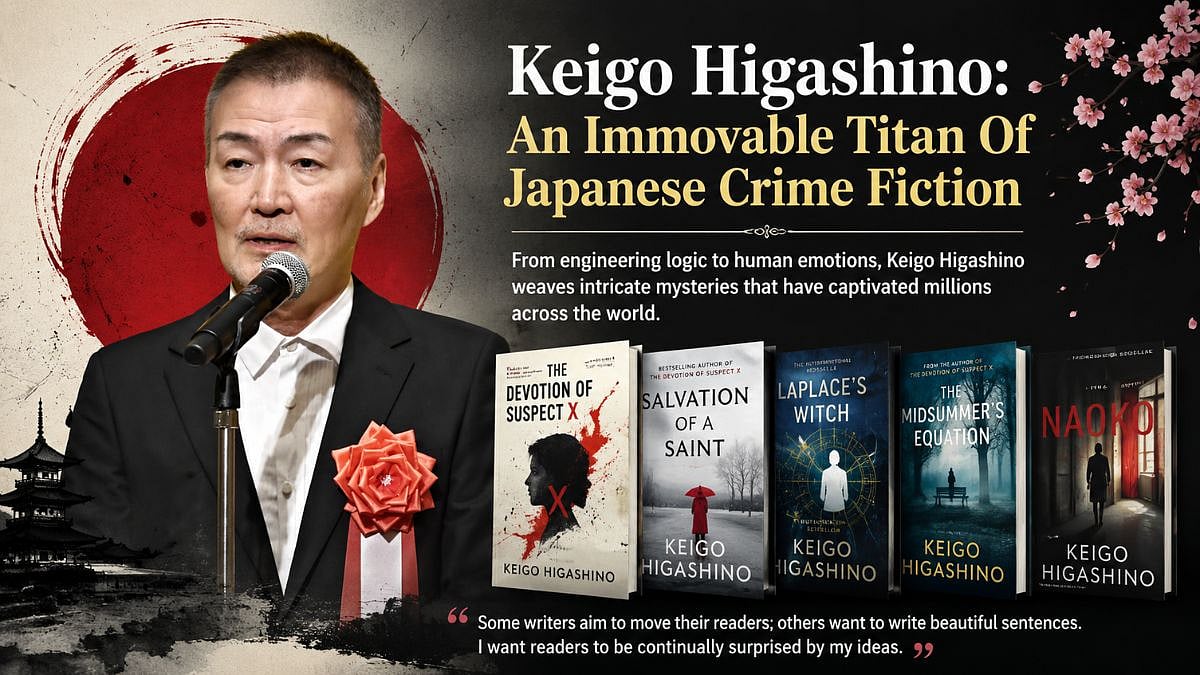
In the hyper-competitive ecosystem of Japanese crime fiction—where hundreds of meticulous mysteries and thrillers flood the market annually—Keigo Higashino stands as an immovable titan. Operating within a crowded literary scene that churns out staggering volumes of genre fiction year after year, Higashino’s legacy rests not merely on prolific output but also on an unorthodox craft that defies easy categorisation.
Higashino, who gave up his profession as an electrical engineer when he began flourishing as a writer, created as many as 106 books in the less than seven decades that he lived. Japan recognised him while he was still in his late twenties for his very first novel, in 1985.
It was not until three decades later that the world got to experience this remarkable writer who bridged the gap between mechanical logic and deep human sorrow to secure his place alongside the pantheon of global crime greats.
To an interviewer, he had said, “Some writers aim to move their readers; others want to write beautiful sentences. I want readers to be continually surprised by my ideas.” Cleanly written, quick-moving and immensely accessible, his tribe of readers grew with fierce devotion.
A Literary Universe Beyond Translation
Yet, for English-language readers, accessing this genius is like peering through a keyhole into a dimly lit room. In the darkness is visible a universe where novels hang luminously, like precise spiders’ webs, every strand linked intricately and organically to the others, every web a world in itself.
Out of his massive bibliography, alas, fewer than 15 books have been translated into English. We still await reading his breakout novel in English, first published in the mid-1980s. This disconnect highlights the monumental role played by dedicated translators, who act as vital cultural conduits, carrying culture-rich narratives across a vast linguistic divide.
While works like Laplace’s Witch and Naoko remained for long outside standard English reach, other translated masterworks like Salvation of a Saint beautifully showcase his trademark fusion of rigorous police procedure and psychological depth.
Master Of The Unexpected
Higashino sometimes chose to display his uncanny mastery in marrying magical realism and speculative phenomena with strict procedural mechanics as well. Rather than treating the uncanny as a gimmick, he grounded impossible or ethereal elements in rigid reality, interrogating the metaphysical just as intensely as any human suspect, such as in Midsummer’s Equation.
Higashino's global reach is best epitomised by the monumental success of The Devotion of Suspect X. A true global blockbuster, it has inspired at least five major film adaptations across various languages and cinematic traditions—including Japanese, South Korean, Chinese, Tamil, Hindi and, of course, Malayalam, the language that introduced him to India. Perhaps it is not too late for his other works to find their place under the English-language sun.

