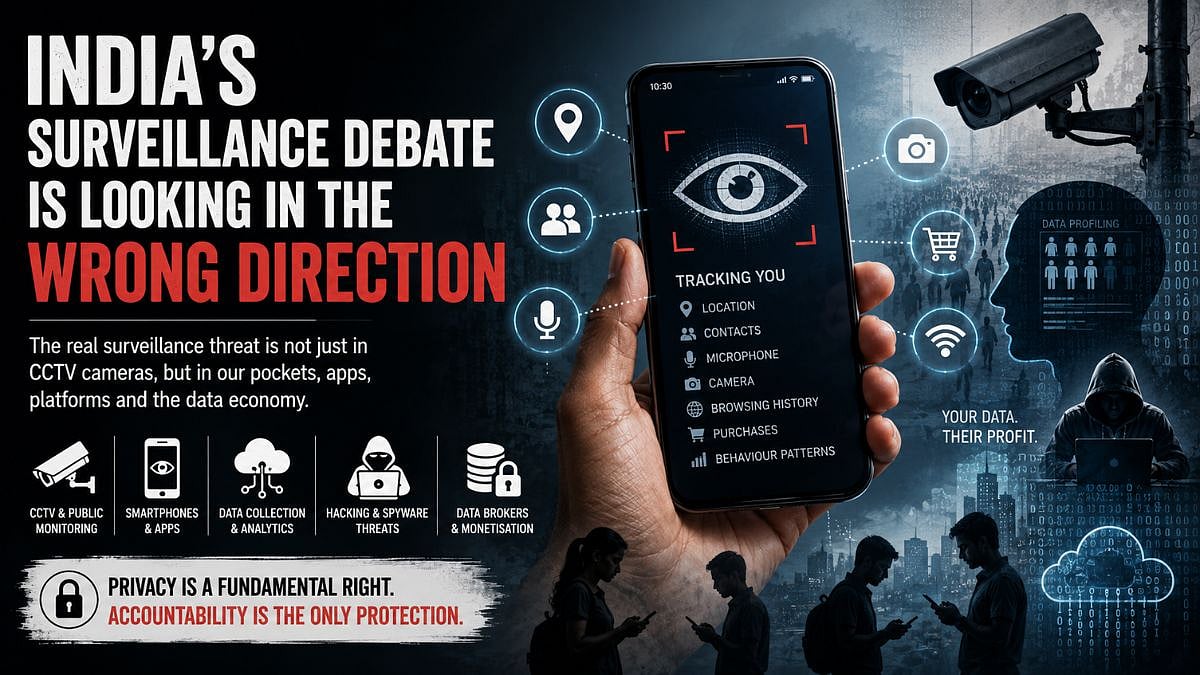
India's surveillance debate is trapped in the last decade. Every time concerns about privacy emerge, public attention gravitates towards CCTV cameras, facial recognition systems and monitoring in public spaces. Yet, the most pervasive forms of surveillance today are not mounted on street corners.
They sit quietly in our pockets, on our desks, and increasingly within the digital infrastructure that powers modern life. The surveillance challenge confronting India is no longer confined to what a camera can capture; it is embedded in smartphones, intrusive applications, microphones, digital platforms, data brokers, and increasingly sophisticated methods of collecting, analysing and monetising personal information.
If India is serious about protecting the constitutional right to privacy, it must recognise that surveillance has evolved far beyond the lens of a CCTV camera.
India's digital transformation has been one of the defining economic stories of the past decade. Hundreds of millions of citizens now rely on smartphones for banking, healthcare, education, commerce and access to government services.
The growth of digital public infrastructure has created enormous opportunities for inclusion and economic efficiency. Yet, the expansion of digital services has not always been accompanied by equally robust protections for privacy and data security.
Many applications routinely seek access to contacts, cameras, microphones, location services and device storage, often beyond what appears necessary for their stated purpose.
In theory, users provide consent. In practice, few understand the scale of information being collected or how it may eventually be used. Consent has become a procedural requirement rather than an informed choice.
The issue extends beyond applications and permissions. Modern smartphones continuously generate data about movement, habits, preferences, purchases, relationships and communication patterns.
Combined, these fragments create remarkably detailed profiles of individual lives. Such information carries immense economic value, making data one of the most sought-after assets in the modern economy.
Beyond Government Surveillance
This is where the surveillance debate becomes more consequential. Public discussion often focuses on the possibility of government overreach while overlooking the vast quantities of information already held by private entities.
Technology companies, digital platforms, advertising networks and data analytics firms possess unprecedented insight into the behaviour of ordinary citizens. In many cases, individuals have little visibility into how their information is processed once it enters these systems.
There is also the growing threat of unethical hacking and covert digital intrusion. Around the world, spyware scandals and cyber espionage incidents have demonstrated that personal devices can be converted into surveillance tools without the owner's knowledge.
Such capabilities raise legitimate concerns about accountability and oversight. National security remains a valid objective, but surveillance powers, whether exercised by governments or enabled through private actors, cannot exist without meaningful checks and balances.
The Data Economy's Accountability Deficit
Popular culture recognised these concerns long before policymakers fully confronted them. The television series Person of Interest (released in 2016) imagined a world where technology could track, predict and monitor human behaviour at scale.
More recently, the Malayalam film Patriot (2026) explored similar anxieties around surveillance, power and personal freedom. Both works employ creative licence, as fiction inevitably does.
Yet, their relevance endures because they address questions that remain unresolved in the real world. Who controls the information generated by citizens? How much monitoring is acceptable in the name of security, convenience or commercial efficiency? What safeguards exist against misuse?
These questions resonate strongly in India because digital adoption has advanced at an extraordinary speed while data literacy remains uneven. Millions of citizens interact with complex digital ecosystems every day without fully understanding how personal information is harvested, shared, analysed or retained. Audiences may watch such stories for entertainment, but the concerns underpinning them are not fictional.
Most importantly, there remains little evidence available to assure citizens that the vast amounts of data collected through applications, devices and platforms are consistently safe once they pass into private hands.
Data breaches, leaks and cyber-attacks have become recurring features of the global digital economy. The assumption that organisations collecting data will always protect it responsibly is not a substitute for accountability.
Building Trust In The Digital Age
India has taken important steps towards establishing a data protection framework. However, legislation alone cannot guarantee trust. Effective privacy protection requires independent oversight, transparent governance, strict limitations on data collection, strong cybersecurity standards and meaningful consequences for misuse.
Citizens must possess enforceable rights rather than rely on assurances.
For a country seeking to become a global digital powerhouse, this is no longer merely a privacy debate; it is a governance, economic and institutional credibility issue.
Trust is the currency on which digital economies are built. Citizens who do not trust how their data is collected, stored or used will eventually become reluctant participants in the very systems designed to empower them.
India does not face a choice between technology and privacy. It faces a choice between accountable technology and unaccountable technology. Surveillance may be justified in specific circumstances. Data collection may be necessary for innovation and growth. But neither can be allowed to operate on the basis of trust alone.
The defining question for India's digital future is simple: who benefits from the collection of citizens' data, and who bears responsibility when that trust is broken?
Unless policymakers answer that question with clarity and urgency, India risks creating an economy where data is protected less rigorously than capital. No modern financial system can thrive under such an imbalance, and no democracy should be comfortable with it.
Kalyani Srinath, a food curator and columnist, blogs at https://www.sizzlingtastebuds.com.

