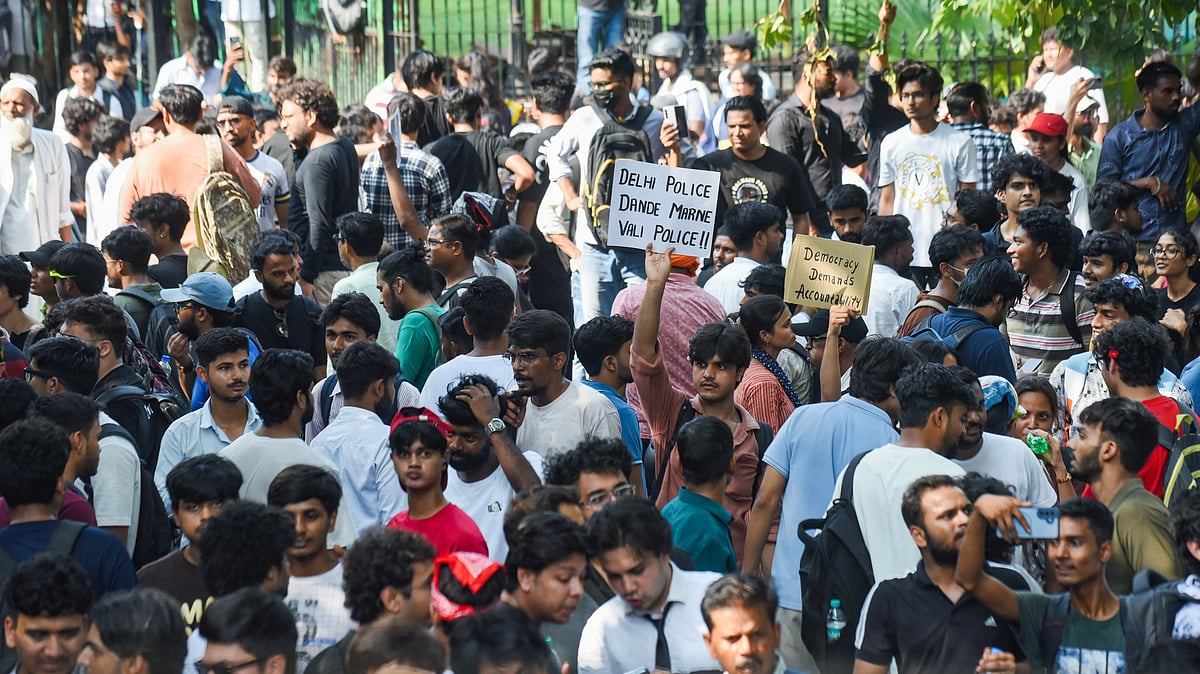
Something has changed in India over the past fortnight. For a long time, criticising the BJP-led NDA government and its leadership was quite difficult, if not entirely unthinkable, for most people. But the Cockroach Janta Party (CJP) protests made it possible in ways many people didn’t imagine. The moment it became realistic, the floodgates opened, and the protests against the government’s repeated failures to prevent leaks of national exam papers became an enduring portrait of democratic dissent against a host of issues that people were afraid to talk about earlier. In that sense, the CJP protests have done what the opposition parties have been unable to do for over 12 years: to force the government to climb down from its pride of power.
The CJP agitation that attracted a broader participation of a large number of students may have ended with education minister Dharmendra Pradhan’s resignation and other key demands of the students being accepted by the government, but what the movement captured is not just frustration over paper leaks but also the broader grievances against the education system, besides larger concerns over allegations of rising corruption, record youth unemployment, lack of accountability, and declining trust in democratic institutions. All attempts at ignoring, discrediting, and diverting tactics that the government employed against all earlier protests did not work this time; neither did the attempt to suppress it with police violence.
The overarching strategy to project strength—defined by never backing down, never explaining, and narrative building—may have been successful in the past, but this time the sheer determination of protesting youth forced the government to yield to their demands. The government accepted the students’ demands only when it realised that there was no other option left. If the protests were about reforms in exams and the education system at one level, side by side they were also about accountability for the government’s decisions and actions, good governance, freedom, political morality, democratic rights, and India’s future, which they see in quality education and good employment opportunities for all.
Perhaps the most striking feature of the protest was the CJP’s ability to play the role of an Opposition in the national political space outside the Parliament by harnessing anger over the failing education system and turning it into a broader movement whose face was repeated paper leaks, while the narrative was all-encompassing discontent against the government over a host of issues and problems that the common man faces. From this perspective, the protests can be interpreted as an indictment of the government as well as of the Opposition, which is divided, under-resourced, and unable to mount a challenge to the powerful government. It may not be an exaggeration to add that using social media, the strength of the ruling dispensation, the CJP filled the political vacuum by directly competing with the government’s narrative to drive widespread support for its protests.
What can be added to the mix of discontent and anger are the persistent problems of skewed economic growth, crony capitalism, and employment prospects being impacted by AI. Equally important is the growing anti-incumbency against the government, which is almost half-way through its third term. For a government that promised to transform the country, Indians are still far away from the promises of all-round development, better living conditions, and corruption-free governance. The gap between promise and delivery is quite wide and extends to every aspect of life, which the government’s propaganda machinery has tried but failed to cover up with narratives and campaigns claiming India’s “unprecedented” transformation under the current leadership.
Come to think of it, in a poor but developing country like India, for every young citizen, particularly the middle class youth, education is the principal vehicle for economic empowerment and social mobility. Poor quality of education and leaky exams rob students of the only opportunity they have to improve their lot and control their own lives. But when the process of economic and social empowerment that enables individuals and marginalised groups to access rights, opportunities, and resources is manipulated, the sense of injustice permeates through a large section of the aspirational population, cutting across religion, caste, and class. This was evident in the motley mix of young people at Jantar Mantar, in Delhi’s streets and elsewhere in many cities where students organised protests in solidarity with the CJP movement.
Pradhan’s forced resignation, rather than a voluntary act that should have come from the former minister accepting moral responsibility, is being viewed as a political defeat for the Narendra Modi government. It also reflects poorly on the government’s non-receptive conduct to the voices of the Opposition, civil society, farmers, labourers, and the poor. The BJP may be on the backfoot now, but it would be a folly to compare these protests with Gen Z-led movements in our neighbouring countries or the nationwide movement in India in the mid-1970s and the 2011 anti-corruption movement, both resulting in government changes. However, the success of the CJP protests is a much-needed respite from the ecosystem of fear. It has unlocked the desire to speak up and given a voice to the discontent and anger of the student community, which resonated with the wider nation.
Having been jolted from its comfort zone, the protests have reminded the government that the youth are not impressed by narratives around the country’s development and “impressive” GDP numbers, infrastructure push, and Amrit Kaal and Viksit Bharat slogans. They want serious reforms in the education sector and the overhaul of the national exam architecture, not patchworks. They want jobs and policy actions, not just promises. While Pradhan has resigned, the CJP’s argument is that he was just a proxy for the Prime Minister. By damaging the Prime Minister’s carefully cultivated image as a universally popular leader, the success of the protests lies in the fact that they succeeded in extracting a minister’s resignation from a government that has often treated electoral victories as carte blanche for policymaking.
However, the deeper economic anxieties and other concerns that fuelled the wave of youth anger and frustration remain unresolved.
The writer is a senior independent Mumbai-based journalist. He tweets at @ali_chougule

