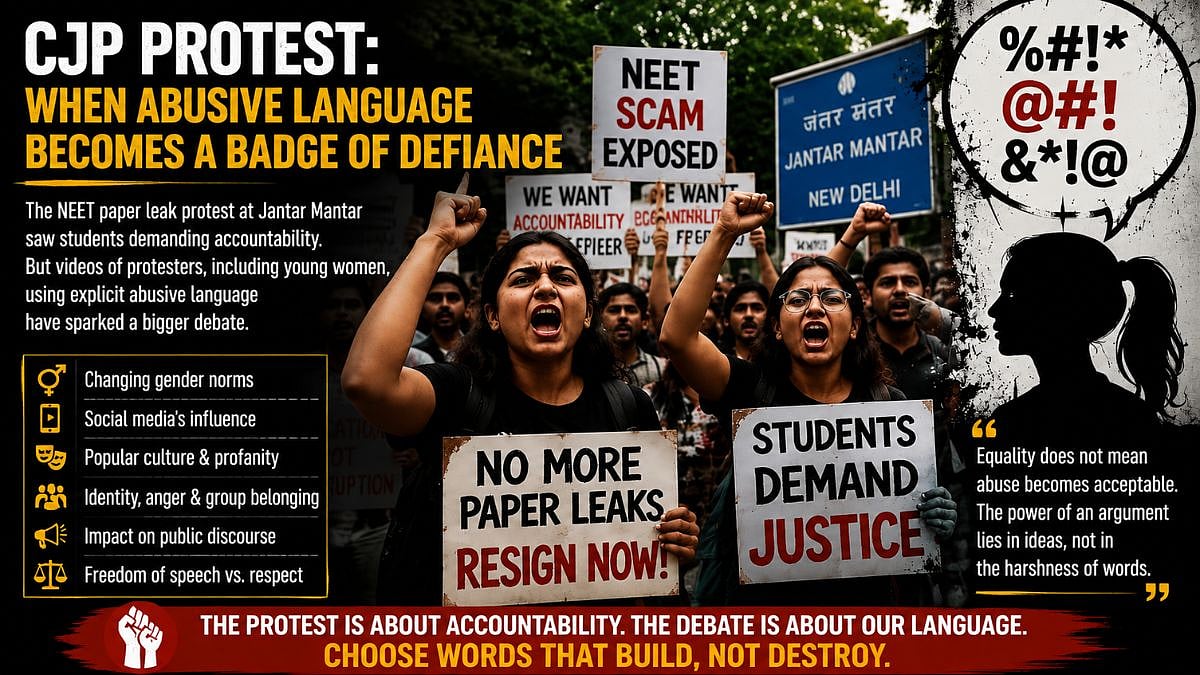
The recent protest at Delhi's Jantar Mantar over the alleged NEET paper leak was expected to be remembered for its demand for accountability. Thousands of students gathered to express their anger over repeated examination irregularities and sought the resignation of the Union Education Minister. Young women participated in large numbers, reflecting the changing face of student activism.
Yet another aspect of the demonstration generated an equally intense debate. Videos circulating on social media showed several protesters, including young women, using explicit abusive language during speeches and interviews. Some of them later posted apology videos, saying they had spoken in the heat of the moment or had not anticipated the public backlash. The episode raises a larger question: Why is abusive language becoming increasingly common among young women? Is it a sign of changing gender norms, the influence of social media, or evidence that public discourse itself is becoming more aggressive?
Patriarchal Roots Of Abuse
For decades, scholars studying language and gender have argued that most abusive expressions in Indian languages are deeply rooted in patriarchy. The harshest insults target women's bodies, sexuality or family relationships. Traditionally, men used such language against other men to establish dominance or display masculinity. The abuse was rarely about women alone. It was about power.
This is why many feminist scholars described abusive language as a tool of patriarchal control. Women's bodies became symbols of male honour, and insulting them became a way of humiliating another man. The language reflected a social order in which women were viewed as extensions of male identity.
What appears to be changing today is not the vocabulary but the identity of those using it. A section of Generation Z increasingly treats profanity as gender-neutral. Young women now use expressions once confined to male hostels, political rallies, sports grounds and workplaces. For many, this language is seen as a sign of confidence and equality rather than vulgarity.
The argument often advanced is straightforward. If men can use abusive language without being morally judged, why should women be held to different standards? Equality, according to this view, means enjoying the same linguistic freedom.
There is merit in questioning this double standard. Women should not face stricter moral scrutiny than men. However, equal freedom does not necessarily mean that every form of expression deserves celebration. A vocabulary historically created to demean women does not lose its misogynistic roots simply because women begin using it. The words remain the same even if the speaker changes.
Social Media And Cultural Influence
Social media has accelerated this transformation. Platforms reward outrage, confrontation and shock value. A measured argument may attract little attention, while an aggressive slogan or abusive remark can become viral within hours. Young users quickly learn that controversy generates visibility. In such an environment, language becomes performance rather than communication.
Popular culture has reinforced the trend. Films, streaming platforms, stand-up comedy and rap music increasingly rely on explicit language in the name of realism. Continuous exposure gradually removes the stigma associated with profanity. Generation Z has grown up consuming content where abusive language is portrayed as natural, humorous or fashionable.
Sociologists point out that abuse is not merely an expression of anger; it is also a marker of identity and group belonging. In many peer circles, swearing signals confidence, authenticity and toughness. Those who avoid such language risk appearing timid or out of touch. This pressure influences young men and women alike.
The debate, therefore, should not focus exclusively on women. Men continue to use abusive language more frequently, yet society seldom treats it as a cultural crisis. The visibility of women using similar language attracts disproportionate attention because it challenges traditional expectations of femininity. The controversy is, therefore, as much about changing gender roles as it is about language itself.
Public Discourse And Responsibility
Language influences the quality of public discourse. When political debate begins to resemble social media trolling, disagreement becomes abuse and discussion turns into spectacle. Profanity may energise supporters, but it rarely persuades opponents. Democracies thrive on robust debate, not verbal intimidation.
The reaction to the Jantar Mantar videos also exposed a social contradiction. Many people praised these clips as symbols of boldness and fearless expression. Yet many of the same people would feel uncomfortable if their own daughters or sons adopted similar language at home or in professional settings. Society often applauds rebellion when it belongs to someone else's family while expecting discipline within its own.
The fact that several protesters later apologised is also significant. It suggests they recognised the difference between attracting online attention and earning public respect. Viral fame is fleeting, but reputations endure much longer. Social media rewards instant reactions, while society judges conduct over time.
None of this implies that women should conform to outdated stereotypes of modesty or silence. They have every right to protest, question authority and express anger. Nor should isolated incidents be used to stereotype an entire generation. Most young women, like most young men, continue to articulate their views without resorting to abusive language.
The real issue is not whether women swear as much as men; it is whether Indian society is gradually accepting abuse as a substitute for argument. Equality should expand the space for dignity and mutual respect rather than merely distribute incivility more evenly. If every generation defines freedom by lowering the standards of public discourse, democracy may become louder but not wiser.
Debate Beyond The Protest
The NEET protest will eventually fade from public memory. The debate it has triggered about language, culture and the meaning of empowerment deserves to continue. A confident society should encourage fearless speech, but it should also remember that the power of an argument lies not in the harshness of its vocabulary but in the strength of its ideas.
The writer is a senior journalist. Views expressed are personal.

